Advertisements
Advertisements
प्रश्न
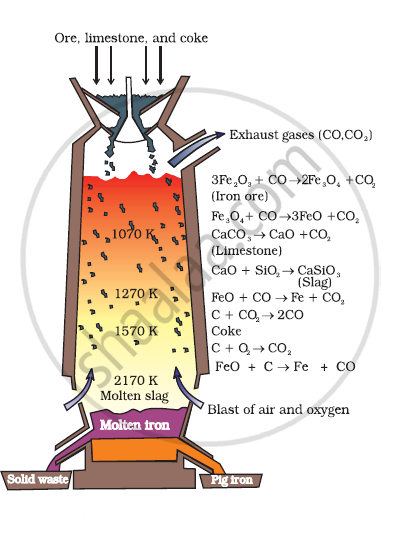
Write down the reactions taking place in different zones in the blast furnace during the extraction of iron.
Advertisements
उत्तर
During the extraction of iron, the reduction of iron oxides takes place in the blast furnace. In this process, hot air is blown from the bottom of the furnace, and coke is burnt to raise the temperature up to 2200 K in the lower portion itself. The temperature is lower in the upper part. Thus, it is the lower part where the reduction of iron oxides (Fe2O3 and Fe3O4) takes place.
The reactions taking place in the lower temperature range (500 − 800 K) in the blast furnace are:
\[\ce{3Fe2O3 + CO -> 2Fe3O4 + CO2}\]
\[\ce{Fe3O4 + 4CO -> 3Fe + 4CO2}\]
\[\ce{Fe2O3 + CO -> 2FeO + CO2}\]
The reactions taking place in the higher temperature range (900-1500 K) in the blast furnace are:
\[\ce{C + CO2 -> 2CO}\]
\[\ce{FeO + CO -> Fe + CO2}\]
The silicate impurity of the ore is removed as slag by calcium oxide (CaO), which is formed by the decomposition of limestone (CaCO3)
\[\ce{CaCO3 -> CaO + CO2}\]
\[\ce{CaO + SiO2 -> \underset{(Slag)}{\underset{Calcium silicate}{CaSiO3}}}\]
संबंधित प्रश्न
How is ‘cast iron’ different from ‘pig iron’?
Is it true that under certain conditions, Mg can reduce SiO2 and Si can reduce MgO? What are those conditions?
Write chemical reactions taking place in the extraction of zinc from zinc blende.
The choice of a reducing agent in a particular case depends on thermodynamic factor. How far do you agree with this statement? Support your opinion with two examples.
Write chemical reactions taking place in the extraction of copper from Cu2 S.
How will you convert the following:
Zinc blende to Zinc metal
The impurity that is added externally to remove the impurity already present in the ore is known as ____________.
In the metallurgy of aluminium ______.
Choose the correct option of temperature at which carbon reduces \[\ce{FeO}\] to iron and produces \[\ce{CO}\].
Below point ‘A’ \[\ce{FeO}\] can ______.
For the reduction of \[\ce{FeO}\] at the temperature corresponding to point D, which of the following statements is correct?
For the metallurgical process of which of the ores calcined ore can be reduced by carbon?
(i) Haematite
(ii) Calamine
(iii) Iron pyrites
(iv) Sphalerite
The purest form of iron is prepared by oxidising impurities from cast iron in a reverberatory furnace. Which iron ore is used to line the furnace? Explain by giving reaction.
Write down the reactions taking place in Blast furnace related to the metallurgy of iron in the temperature range 500-800 K.
Explain the following:
\[\ce{CO2}\] is a better reducing agent below 710 K whereas \[\ce{CO}\] is a better reducing agent above 710 K.
Explain the following:
Silica is added to the sulphide ore of copper in the reverberatory furnace.
Explain the following:
Carbon and hydrogen are not used as reducing agents at high temperatures.
Carbon deposition reaction taking place in ______.
Assertion: For the extraction of iron, haematite ore is used.
Reason: Haematite is a carbonate ore of iron.
