Advertisements
Advertisements
प्रश्न
The choice of a reducing agent in a particular case depends on thermodynamic factor. How far do you agree with this statement? Support your opinion with two examples.
Advertisements
उत्तर १
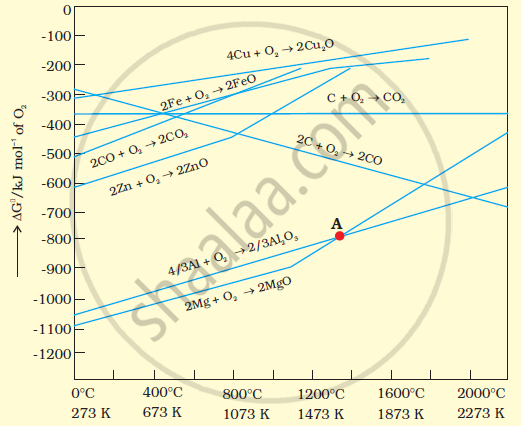
The above figure is a plot of Gibbs energy (ΔG°) vs. T for the formation of some oxides.
It can be observed from the above graph that a metal can reduce the oxide of other metals if the standard free energy of formation (ΔfG°) of the oxide of the former is more negative than the latter. For example, since \[\ce{\Delta_f G^{\circ}_{Al, Al_2, O_3}}\] is more negative than \[\ce{\Delta_f G^{\circ}_{Cu, Cu_2. O}}\], Al can reduce Cu2O to Cu, but Cu cannot reduce Al2O3. Similarly, Mg can reduce ZnO to Zn, but Zn cannot reduce MgO because \[\ce{\Delta_f G^{\circ}_{Mg, MgO}}\] is more negative than \[\ce{\Delta_f G^{\circ}_{Zn, ZnO}}\]
उत्तर २
We can study the choice of a reducing agent in a particular case using an Ellingham diagram.
It is evident from the diagram that metals for which the standard free energy of formation of their oxides is more negative can reduce those metal oxides for which the standard free energy of formation of their respective oxides is less negative. It means that any metal will reduce the oxides of other metals that lie above it in the Ellingham diagram. This is because the standard free energy change (ΔrG°) of the combined redox reaction will be negative by an amount equal to the difference in Δf G° of the two metal oxides. Thus, both Al and Zn can reduce FeO to Fe, but Fe cannot reduce Al2O3 to Al and ZnO to Zn. In the same way, G can reduce ZnO to Zn but not CO.
Only that reagent will be preferred as reducing agent, which will lead to decrease in free energy value (ΔG°) at a certain specific temperature
संबंधित प्रश्न
Is it true that under certain conditions, Mg can reduce SiO2 and Si can reduce MgO? What are those conditions?
Write chemical reactions taking place in the extraction of zinc from zinc blende.
State the role of silica in the metallurgy of copper.
Write chemical reactions taking place in the extraction of copper from Cu2 S.
In the metallurgy of aluminium ______.
Below point ‘A’ \[\ce{FeO}\] can ______.
For the metallurgical process of which of the ores calcined ore can be reduced by carbon?
(i) Haematite
(ii) Calamine
(iii) Iron pyrites
(iv) Sphalerite
How is copper extracted from low grade copper ores?
The purest form of iron is prepared by oxidising impurities from cast iron in a reverberatory furnace. Which iron ore is used to line the furnace? Explain by giving reaction.
Write down the reactions taking place in Blast furnace related to the metallurgy of iron in the temperature range 500-800 K.
Explain the following:
Generally sulphide ores are converted into oxides before reduction.
Explain the following:
Carbon and hydrogen are not used as reducing agents at high temperatures.
Carbon deposition reaction taking place in ______.
Assertion: For the extraction of iron, haematite ore is used.
Reason: Haematite is a carbonate ore of iron.
