Advertisements
Advertisements
Question
Write a short note on the following:
Seals of the Indus Valley
Advertisements
Solution
More than 2,000 seals have been unearthed from various sites. They are generally small, flat, rectangular or square in shape and made of clay, soapstone, and copper. They are skillfully carved with figures of humans and animals such as the unicorn, humped bull, goat, tiger, elephant, etc. These seals were probably used by merchants and traders to stamp goods.
RELATED QUESTIONS
Answer the following question?
Describe the town planning and the drainage system of the Indus Valley Civilisation.
Answer the following question?
Describe the Great Granary. Where has it been found?
Answer the following question?
Name the three social classes of the Indus Valley Civilisation.
State whether the following is true or false.
The Harappans decorated their pottery with various designs.
Give one example to prove that the Indus Valley bronzesmiths were skilled craftspeople.
Text Book Keyword
Ziggurats
Text Book Keyword
Papyrus
To ensure a steady supply of water throughout the year, the Mesopotamian built an ______ and highly developed irrigation system. They also built _______ to control floods.
Fill in the blank.
The Mesopotamians kept a record of the business accounts on _______
Name the greatest contributions of the Mesopotamians in the field of architecture.
Fill in the blanks.
The Nile provided water for ________ and also served as a ____________.
Fill in the blank.
The king of Egypt was known as the _______.
Answer the following question briefly:
Describe the structure of dwelling houses in ancient Egypt.
Answer the following question briefly:
Describe briefly the social structure of ancient Egypt.
The figure on the right is of gods and goddesses.
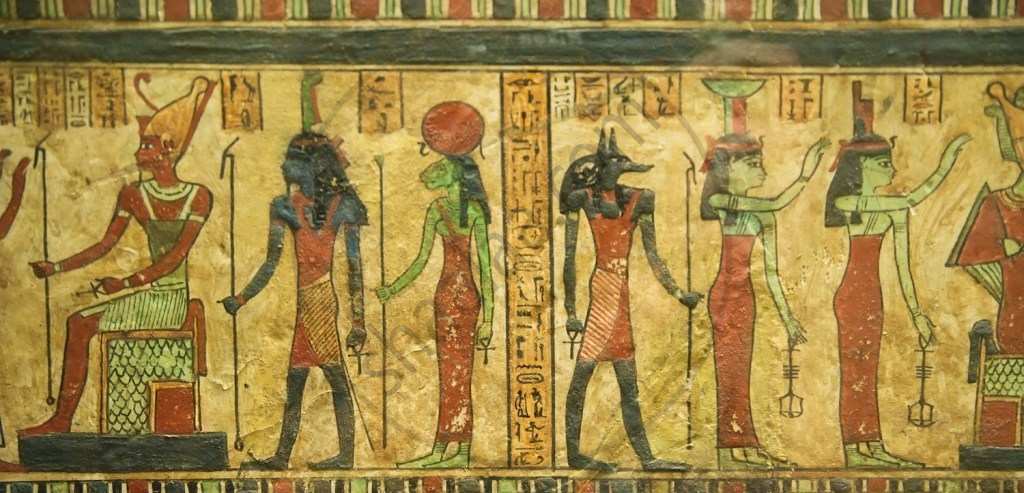
The people of which civilization worshiped these gods and goddesses? What kind of temples did they build?
Match the Columns:
| A | B | ||
| 1 | Huang He | a | mulberry tree |
| 2 | Pagodas | b | God of heaven |
| 3 | Tea | c | stupa-style temples |
| 4 | Silkworms | d | Sorrow of China |
| 5 | Shangdi | e | medicine |
Name the countries with which the Chinese carried on trade?
Which famous Chinese product was the chief item of export in the ancient and medieval ages?
Discuss the main feature of Confucianism?
