Advertisements
Advertisements
Question
The study of objects and artifacts found in the ruins of the Indus Valley cities help us to form an idea of the Harrapan religion. Explain.
Advertisements
Solution
Some of the objects found in the ruins help us to form an idea of the religion of the Harappans. No temples have been found. Numerous smoke-stained clay figures of a female deity have been found. This was probably the Mother Goddess. A three faced figure, seated in a yogic posture and surrounded by various animals is engraved on some seals. The pipal tree was probably regarded as sacred and worshiped. The discovery of a large number of amulets suggests that people probably wore them as lucky charms to ward off evil spirits.
RELATED QUESTIONS
Give reasons why we say that the people of the Indus Valley Civilisation Had an idea of metallurgy
Explanation of keyword:
Great Bath
The Harappan cities had an elaborate drainage system.
State whether the following is true or false.
The Harappans built strong boats.
Give a brief account of Assembly Hall.
Write a short note on the following:
Seals of the Indus Valley
Write True or False against the following statement
The Sumerians developed a system of writing known as Cuneiform.
Text Book Keyword
Papyrus
Match the Following
| Column A | Column B |
| 1. Ziggurats | (a) one of the seven wonders of the ancient world |
| 2. Hanging Gardens of Babylon | (b) temple-tower |
| 3. Cuneiform | (c) sharp reed pen |
| 4. Stylus | (d) code of law |
| 5. Hammurabi | (e) Mesopotamian script |
How do we know that the Mesopotamians had trade links with the people of the Indus Valley?
Write a short note on the following:
Ziggurat
State whether the following is true or false.
The Mesopotamians used the figure of 50 for measuring time.
Fill in the blanks.
The Nile provided water for ________ and also served as a ____________.
The figure on the right is of gods and goddesses.
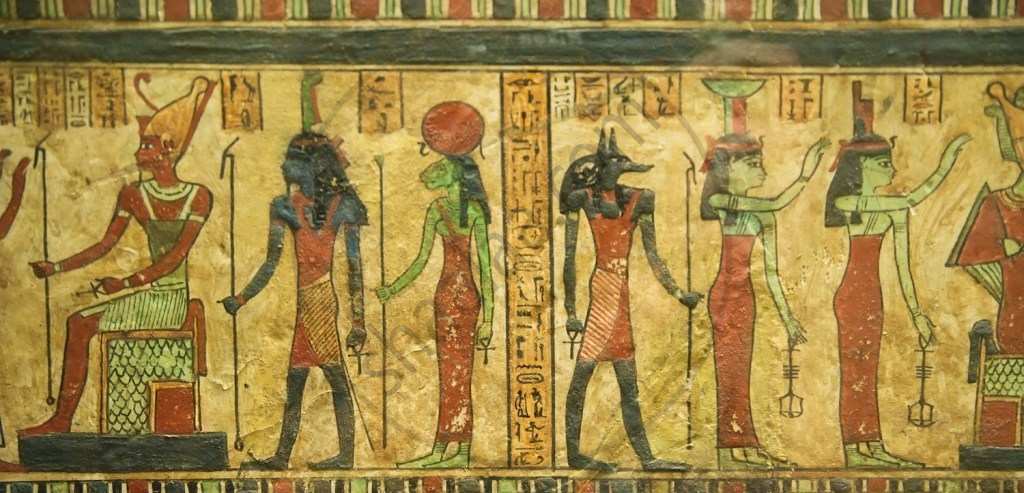
How do we know that they believed in life after death?
What do you know about the religious beliefs and practices of the Harappans?
Fill in the blank.
___________ became the state religion of China.
Which famous Chinese product was the chief item of export in the ancient and medieval ages?
Briefly discuss the characteristic of the Chinese civilization with reference to society
Briefly discuss the characteristic of the Chinese civilization with reference to religion
Describe the religious beliefs of people in ancient Chinese civilization.
