English

Without Expanding the Determinant, Prove that `|(A, A^2,Bc),(B,B^2, Ca),(C, C^2,Ab)| = |(1, A^2, A^3),(1, B^2, B^3),(1, C^2, C^3)| - Mathematics

Advertisements
Advertisements

Question

Without expanding the determinant, prove that

`|(a, a^2,bc),(b,b^2, ca),(c, c^2,ab)| = |(1, a^2, a^3),(1, b^2, b^3),(1, c^2, c^3)|`

Advertisements

Solution
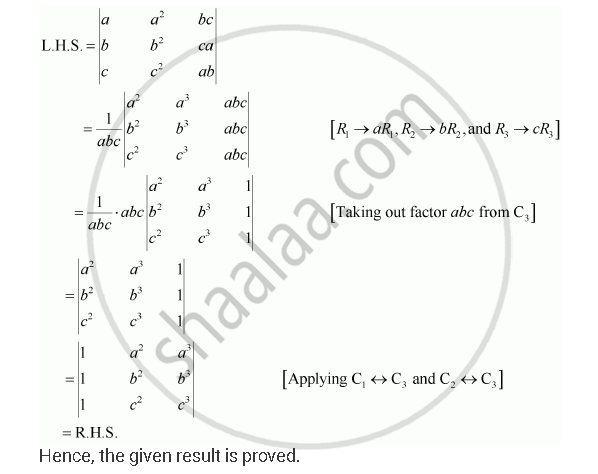
shaalaa.com
  Is there an error in this question or solution?
Chapter 4: Determinants - Exercise 4.7 [Page 141]

APPEARS IN

NCERT Mathematics Part 1 and 2 [English] Class 12
Chapter 4 Determinants
Exercise 4.7 | Q 2 | Page 141

RELATED QUESTIONS

By using properties of determinants, show that:

`|(1,1,1),(a,b,c),(a^3, b^3,c^3)|` = (a-b)(b-c)(c-a)(a+b+c)


Using properties of determinants, prove that:

`|(x, x^2, 1+px^3),(y, y^2, 1+py^3),(z, z^2, 1+pz^2)|` = (1 + pxyz) (x – y) (y – z) (z – x), where p is any scalar.


Using properties of determinants, prove that:

`|(1, 1+p, 1+p+q),(2, 3+2p, 4+3p+2q),(3,6+3p,10+6p+3q)| =  1`                 


Using properties of determinants, prove that 

`|(a^2 + 2a,2a + 1,1),(2a+1,a+2, 1),(3, 3, 1)| = (a - 1)^3`


Using properties of determinants, prove that:

`|(1+a^2-b^2, 2ab, -2b),(2ab, 1-a^2+b^2, 2a),(2b, -2a, 1-a^2-b^2)| = (1 + a^2 + b^2)^3`


Using properties of determinants, prove the following:

`|(a, b,c),(a-b, b-c, c-a),(b+c, c+a, a+b)| = a^3 + b^3 + c^3 - 3abc`.


Solve the following equation: `|(x + 2, x + 6, x - 1),(x + 6, x - 1,x + 2),(x - 1, x + 2, x + 6)|` =  0


Without expanding determinants, show that

`|(1, 3, 6),(6, 1, 4),(3, 7, 12)| + |(2, 3, 3),(2, 1, 2),(1, 7, 6)| = 10|(1, 2, 1),(3, 1, 7),(3, 2, 6)|`


Without expanding determinants, find the value of `|(2014, 2017, 1),(2020, 2023, 1),(2023, 2026, 1)|`


Without expanding determinants, prove that `|("a"_1, "b"_1, "c"_1),("a"_2, "b"_2, "c"_2),("a"_3, "b"_3, "c"_3)| = |("b"_1, "c"_1, "a"_1),("b"_2, "c"_2, "a"_2),("b"_3, "c"_3, "a"_3)| = |("c"_1, "a"_1, "b"_1),("c"_2, "a"_2, "b"_2),("c"_3, "a"_3, "b"_3)|` 


Without expanding the determinants, show that `|(0, "a", "b"),(-"a", 0, "c"),(-"b", -"c", 0)|` = 0


Prove that `|(x + y, y + z, z + x),(z + x, x + y, y + z),(y + z, z + x, x + y)| = 2|(x, y, z),(z, x, y),(y, z, x)|`


Using properties of determinant show that

`|("a" + "b", "a", "b"),("a", "a" + "c", "c"),("b", "c", "b" + "c")|` = 4abc


Without expanding determinants show that

`|(1, 3, 6),(6, 1, 4),(3, 7, 12)| + 4|(2, 3, 3),(2, 1, 2),(1, 7, 6)| = 10|(1, 2, 1),(3, 1, 7),(3, 2, 6)|`


Select the correct option from the given alternatives:

The determinant D = `|("a", "b", "a" + "b"),("b", "c", "b" + "c"),("a" + "b", "b" + "c", 0)|` = 0 if


Select the correct option from the given alternatives:

The value of a for which system of equation a3x + (a + 1)3 y + (a + 2)3z = 0 ax + (a +1)y + (a + 2)z = 0 and x + y + z = 0 has non zero Soln. is


Select the correct option from the given alternatives:

If `|(6"i", -3"i", 1),(4, 3"i", -1),(20, 3, "i")|` = x + iy then


Answer the following question:

Evaluate `|(101, 102, 103),(106, 107, 108),(1, 2, 3)|` by using properties


Answer the following question:

By using properties of determinant prove that `|(x + y, y + z, z + x),(z, x, y),(1, 1, 1)|` = 0


Answer the following question:

If `|("a", 1, 1),(1, "b", 1),(1, 1, "c")|` = 0 then show that `1/(1 - "a") + 1/(1 - "b") + 1/(1 - "c")` = 1


Evaluate: `|(0, xy^2, xz^2),(x^2y, 0, yz^2),(x^2z, zy^2, 0)|`


Prove that: `|(y^2z^2, yz, y + z),(z^2x^2, zx, z + x),(x^2y^2, xy, x + y)|` = 0


Prove that: `|("a"^2 + 2"a", 2"a" + 1, 1),(2"a" + 1, "a" + 2, 1),(3, 3, 1)| = ("a" - 1)^3`


Find the value of θ satisfying `[(1, 1, sin3theta),(-4, 3, cos2theta),(7, -7, -2)]` = 0


The value of the determinant `|(x , x + y, x + 2y),(x + 2y, x, x + y),(x + y, x + 2y, x)|` is ______.


If cos2θ = 0, then `|(0, costheta, sin theta),(cos theta, sin theta,0),(sin theta, 0, cos theta)|^2` = ______.


`|(x + 1, x + 2, x + "a"),(x + 2, x + 3, x + "b"),(x + 3, x + 4, x + "c")|` = 0, where a, b, c are in A.P.


The value of the determinant `abs ((alpha, beta, gamma),(alpha^2, beta^2, gamma^2),(beta + gamma, gamma + alpha, alpha + beta)) =` ____________.


If the ratio of the H.M. and GM. between two numbers a and bis 4 : 5, then a: b is


`f : {1, 2, 3) -> {4, 5}` is not a function, if it is defined by which of the following?


The value of the determinant `|(1, cos(β - α), cos(γ - α)),(cos(α - β), 1, cos(γ - β)),(cos(α - γ), cos(β - γ), 1)|` is equal to ______.


Let a, b, c be such that b(a + c) ≠ 0 if

`|(a, a + 1, a - 1),(-b, b + 1, b - 1),(c, c - 1, c + 1)| + |(a + 1, b + 1, c - 1),(a - 1, b - 1, c + 1),((-1)^(n + 2)a, (-1)^(n + 1)b, (-1)^n c)|` = 0, then the value of n is ______.


If f(α) = `[(cosα, -sinα, 0),(sinα, cosα, 0),(0, 0, 1)]`, prove that f(α) . f(– β) = f(α – β).


By using properties of determinant prove that `|(x + y, y+z, z +x),(z,x,y),(1,1,1)| =0`


By using properties of determinant prove that `|(x+y,y+z,z+x),(z,x,y),(1,1,1)|` = 0.


Without expanding determinant find the value of `|(10,57,107),(12,64,124),(15,78,153)|`


By using properties of determinants, prove that 

`|(x+y, y+z, z+x),(z, x, y),(1, 1, 1)|` = 0 


Share
Notifications

Englishहिंदीमराठी


      Forgot password?
Use app×