Advertisements
Advertisements
प्रश्न
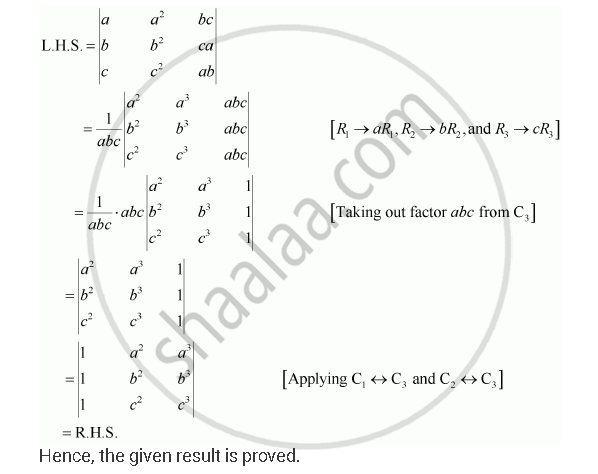
Without expanding the determinant, prove that
`|(a, a^2,bc),(b,b^2, ca),(c, c^2,ab)| = |(1, a^2, a^3),(1, b^2, b^3),(1, c^2, c^3)|`
Advertisements
उत्तर

APPEARS IN
संबंधित प्रश्न
Using the property of determinants and without expanding, prove that:
`|(1, bc, a(b+c)),(1, ca, b(c+a)),(1, ab, c(a+b))| = 0`
By using properties of determinants, show that:
`|(0,a, -b),(-a,0, -c),(b, c,0)| = 0`
By using properties of determinants, show that:
`|(x+4,2x,2x),(2x,x+4,2x),(2x , 2x, x+4)| = (5x + 4)(4-x)^2`
Using properties of determinants, prove that:
`|(x, x^2, 1+px^3),(y, y^2, 1+py^3),(z, z^2, 1+pz^2)|` = (1 + pxyz) (x – y) (y – z) (z – x), where p is any scalar.
Using properties of determinants, prove that
`|(a^2 + 2a,2a + 1,1),(2a+1,a+2, 1),(3, 3, 1)| = (a - 1)^3`
Using properties of determinants, prove that `|(x,x+y,x+2y),(x+2y, x,x+y),(x+y, x+2y, x)| = 9y^2(x + y)`
Using properties of determinants, prove the following :
Prove the following using properties of determinants :
\[\begin{vmatrix}a + b + 2c & a & b \\ c & b + c + 2a & b \\ c & a & c + a + 2b\end{vmatrix} = 2\left( a + b + c \right) {}^3\]
Using propertiesof determinants prove that:
`|(x , x(x^2), x+1), (y, y(y^2 + 1), y+1),( z, z(z^2 + 1) , z+1) | = (x-y) (y - z)(z - x)(x + y+ z)`
Using properties of determinants, prove that
`|[b+c , a ,a ] ,[ b , a+c, b ] ,[c , c, a+b ]|` = 4abc
Using properties of determinants, prove that:
`|[a^2 + 1, ab, ac], [ba, b^2 + 1, bc ], [ca, cb, c^2+1]| = a^2 + b^2 + c^2 + 1`
Using properties of determinant prove that
`|(b+c , a , a), (b , c+a, b), (c, c, a+b)|` = 4abc
Solve for x : `|("a"+"x","a"-"x","a"-"x"),("a"-"x","a"+"x","a"-"x"),("a"-"x","a"-"x","a"+"x")| = 0`, using properties of determinants.
Using properties of determinants, show that `|("a" + "b", "a", "b"),("a", "a" + "c", "c"),("b", "c", "b" + "c")|` = 4abc.
Solve the following equation: `|(x + 2, x + 6, x - 1),(x + 6, x - 1,x + 2),(x - 1, x + 2, x + 6)|` = 0
Without expanding determinants, show that
`|(1, 3, 6),(6, 1, 4),(3, 7, 12)| + |(2, 3, 3),(2, 1, 2),(1, 7, 6)| = 10|(1, 2, 1),(3, 1, 7),(3, 2, 6)|`
Without expanding determinants, prove that `|(1, yz, y + z),(1, zx, z + x),(1, xy, x + y)| = |(1, x, x^2),(1, y, y^2),(1, z, z^2)|`.
By using properties of determinants, prove that `|(x + y, y + z, z + x),(z, x, y),(1, 1, 1)|` = 0.
Without expanding the determinants, show that `|(0, "a", "b"),(-"a", 0, "c"),(-"b", -"c", 0)|` = 0
Without expanding evaluate the following determinant:
`|(1, "a", "b" + "c"),(1, "b", "c" + "a"),(1, "c", "a" + "b")|`
Without expanding evaluate the following determinant:
`|(2, 7, 65),(3, 8, 75),(5, 9, 86)|`
Select the correct option from the given alternatives:
Let D = `|(sintheta*cosphi, sintheta*sinphi, costheta),(costheta*cosphi, costheta*sinphi, -sintheta),(-sintheta*sinphi, sintheta*cosphi, 0)|` then
Answer the following question:
Evaluate `|(2, 3, 5),(400, 600, 1000),(48, 47, 18)|` by using properties
Answer the following question:
Without expanding determinant show that
`|("b" + "c", "bc", "b"^2"c"^2),("c" + "a", "ca", "c"^2"a"^2),("a" + "b", "ab", "a"^2"b"^2)|` = 0
Answer the following question:
Without expanding determinant show that
`|(x"a", y"b", z"c"),("a"^2, "b"^2, "c"^2),(1, 1, 1)| = |(x, y, z),("a", "b", "c"),("bc", "ca", "ab")|`
Evaluate: `|(0, xy^2, xz^2),(x^2y, 0, yz^2),(x^2z, zy^2, 0)|`
Evaluate: `|("a" - "b" - "c", 2"a", 2"a"),(2"b", "b" - "c" - "a", 2"b"),(2"c", 2"c", "c" - "a" - "b")|`
Prove that: `|(y + z, z, y),(z, z + x, x),(y, x, x + y)|` = 4xyz
The maximum value of Δ = `|(1, 1, 1),(1, 1 + sin theta, 1),(1 + cos theta, 1, 1)|` is ______. (θ is real number)
The determinant `|(sin"A", cos"A", sin"A" + cos"B"),(sin"B", cos"A", sin"B" + cos"B"),(sin"C", cos"A", sin"C" + cos"B")|` is equal to zero.
Let P be any non-empty set containing p elements. Then, what is the number of relations on P?
A system of linear equations represented in matrix form Ax = 0, A is n × n matrix, has a non-zero solution if the determinant of A (i.e., det(A)) is
If f(α) = `[(cosα, -sinα, 0),(sinα, cosα, 0),(0, 0, 1)]`, prove that f(α) . f(– β) = f(α – β).
Without expanding determinants find the value of `|(10,57,107), (12, 64, 124), (15, 78, 153)|`
Without expanding evaluate the following determinant.
`|(1, a, a + c),(1, b, c + a),(1, c, a + b)|`
Without expanding determinants find the value of `|(10,57,107),(12,64,124),(15,78,153)|`
Without expanding evaluate the following determinant.
`|(1,"a","b+c"),(1,"b","c+a"),(1,"c","a+b")|`
By using properties of determinant prove that `|(x+y,y+z,z+x),(z,x,y),(1,1,1)|` = 0.
