हिंदी

Without Expanding the Determinant, Prove that `|(A, A^2,Bc),(B,B^2, Ca),(C, C^2,Ab)| = |(1, A^2, A^3),(1, B^2, B^3),(1, C^2, C^3)| - Mathematics

Advertisements
Advertisements

प्रश्न

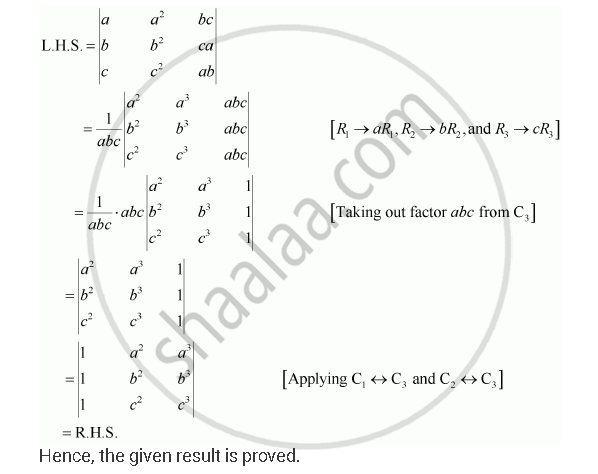
Without expanding the determinant, prove that

`|(a, a^2,bc),(b,b^2, ca),(c, c^2,ab)| = |(1, a^2, a^3),(1, b^2, b^3),(1, c^2, c^3)|`

Advertisements

उत्तर

shaalaa.com
  क्या इस प्रश्न या उत्तर में कोई त्रुटि है?
अध्याय 4: Determinants - Exercise 4.7 [पृष्ठ १४१]

APPEARS IN

एनसीईआरटी Mathematics Part 1 and 2 [English] Class 12
अध्याय 4 Determinants
Exercise 4.7 | Q 2 | पृष्ठ १४१

संबंधित प्रश्न


If ` f(x)=|[a,-1,0],[ax,a,-1],[ax^2,ax,a]| ` , using properties of determinants find the value of f(2x) − f(x).


Using the property of determinants and without expanding, prove that:

`|(2,7,65),(3,8,75),(5,9,86)| = 0`


By using properties of determinants, show that:

`|(0,a, -b),(-a,0, -c),(b, c,0)| = 0`


By using properties of determinants, show that:

`|(1,a,a^2),(1,b,b^2),(1,c,c^2)| = (a - b)(b-c)(c-a)`


Evaluate `|(x, y, x+y),(y, x+y, x),(x+y, x, y)|`


Using properties of determinants, prove that `|(x,x+y,x+2y),(x+2y, x,x+y),(x+y, x+2y, x)| = 9y^2(x + y)`


Using properties of determinants, prove the following :

\[\begin{vmatrix}1 & a & a^2 \\ a^2 & 1 & a \\ a & a^2 & 1\end{vmatrix} = \left( 1 - a^3 \right)^2\].

Using properties of determinants, prove that

`|[b+c , a ,a  ] ,[ b , a+c, b ] ,[c , c, a+b ]|` = 4abc 


Using properties of determinants, prove that:

`|(a,b,b+c),(c,a,c+a),(b,c,a+b)|` = (a+b+c)(a-c)2 


Evaluate the following determinants:

`|(x - 1, x, x - 2),(0, x - 2, x - 3),(0, 0, x - 3)| = 0`


Without expanding evaluate the following determinant:

`|(1, "a", "b" + "c"),(1, "b", "c" + "a"),(1, "c", "a" + "b")|`


Without expanding determinants, show that

`|(1, 3, 6),(6, 1, 4),(3, 7, 12)| + |(2, 3, 3),(2, 1, 2),(1, 7, 6)| = 10|(1, 2, 1),(3, 1, 7),(3, 2, 6)|`


Without expanding the determinant, find the value of `|(10, 57, 107),(12, 64, 124),(15, 78, 153)|`.


Without expanding the determinants, show that `|("b" + "c", "bc", "b"^2"c"^2),("c" + "a", "ca", "c"^2"a"^2),("a" +  "b", "ab", "a"^2"b"^2)|` = 0


Without expanding the determinants, show that `|(0, "a", "b"),(-"a", 0, "c"),(-"b", -"c", 0)|` = 0


Using properties of determinant show that

`|("a" + "b", "a", "b"),("a", "a" + "c", "c"),("b", "c", "b" + "c")|` = 4abc


Using properties of determinant show that

`|(1, log_x y, log_x z),(log_y x, 1, log_y z),(log_z x, log_z y, 1)|` = 0


If `|("x"^"k", "x"^("k" + 2), "x"^("k" + 3)),("y"^"k", "y"^("k" + 2), "y"^("k" + 3)),("z"^"k", "z"^("k" + 2), "z"^("k" + 3))|` = (x - y) (y - z) (z - x)`(1/"x"+ 1/"y" + 1/"z") ` then


Select the correct option from the given alternatives:

Let D = `|(sintheta*cosphi, sintheta*sinphi, costheta),(costheta*cosphi, costheta*sinphi, -sintheta),(-sintheta*sinphi, sintheta*cosphi, 0)|` then


Answer the following question:

Without expanding determinant show that

`|("b" + "c", "bc", "b"^2"c"^2),("c" + "a", "ca", "c"^2"a"^2),("a" + "b", "ab", "a"^2"b"^2)|` = 0


Answer the following question:

Without expanding determinant show that

`|(x"a", y"b", z"c"),("a"^2, "b"^2, "c"^2),(1, 1, 1)| = |(x, y, z),("a", "b", "c"),("bc", "ca", "ab")|`


Answer the following question:

Without expanding determinant show that

`|(l, "m", "n"),("e", "d", "f"),("u", "v", "w")| = |("n", "f", "w"),(l, "e", "u"),("m", "d", "v")|`


Answer the following question:

If `|("a", 1, 1),(1, "b", 1),(1, 1, "c")|` = 0 then show that `1/(1 - "a") + 1/(1 - "b") + 1/(1 - "c")` = 1


The value of `|(1, 1, 1),(""^"n""C"_1, ""^("n" + 2)"C"_1, ""^("n" + 4)"C"_1),(""^"n""C"_2, ""^("n" + 2)"C"_2, ""^("n" + 4)"C"_2)|` is 8.


The value of determinant `|("a" - "b", "b" + "c", "a"),("b" - "a", "c" + "a", "b"),("c" - "a", "a" + "b", "c")|` is ______.


If the value of a third order determinant is 12, then the value of the determinant formed by replacing each element by its co-factor will be 144.


If the ratio of the H.M. and GM. between two numbers a and bis 4 : 5, then a: b is


A number consists of two digits and the digit in the ten's place exceeds that in the unit's place by 5. If 5 times the sum of the digits be subtracted from the number, the digits of the number are reversed. Then the sum of digits of the number is:


Which of the following is correct?


Without expanding determinants find the value of `|(10,57,107), (12, 64, 124), (15, 78, 153)|`


Without expanding determinants find the value of `|(10,57,107),(12,64,124),(15,78,153)|`


By using properties of determinant prove that `|(x + y, y+z, z +x),(z,x,y),(1,1,1)| =0`


By using properties of determinant prove that `|(x+y,y+z,z+x),(z,x,y),(1,1,1)|` = 0.


By using properties of determinant prove that `|(x+y,y+z,z+x),(z,x,y),(1,1,1)|` = 0


Without expanding evaluate the following determinant:

`|(1, a, b + c), (1, b, c + a), (1, c, a + b)|`


Without expanding determinant find the value of `|(10,57,107),(12,64,124),(15,78,153)|`


Without expanding evaluate the following determinant.

`|(1, a, b+c),(1, b, c+a),(1, c, a+b)|`


Share
Notifications

Englishहिंदीमराठी


      Forgot password?
Use app×