Advertisements
Advertisements
Question
With whom did the music teacher compared Ravi with?
Advertisements
Solution
The music teacher compared Ravi with the lord Hanuman and called him a Hanuman incarnate.
RELATED QUESTIONS
Match the meanings with the words/expressions in italic, and write the appropriate
meaning next to the sentence.
Paralysed with fear, the boy faced his abductors.
Answer the following question in not more than 100 − 150 words.
Compare and contrast the atmosphere in and around the Baudhnath shrine with the
Pashupathinath temple.
Activity:
Find Dhanuskodi and Rameswaram on the map. What language(s) do you think are spoken there? What languages do you think the author, his family, his friends and his teachers spoke with one another?

Read the diary entry written by Charles Hooper on the day he received the order, Charles Hooper is appointed Assistant National Sales Manager.”
March 1, 19… Thursday 10 pm
Last four years have been eventful. The day I brought Duke home… (Marcy was almost impolite to him because she would have preferred a Pomeranian to a Doberman)… to a stage on October 12, 1957 (when she would not allow anyone else to carry the injured Duke to the vet)… much water has flowed under the bridge. From being a very fit high-charging zone sales manager, I was reduced to a paralysed cripple forced to lie on a bed alone with my thoughts due to a small error by a car driver. Despair had led me on to helplessness… Was I to be a vegetable for the rest of my life ? I never wanted to be a burden on Marcy.
Duke’s re-entry into my life lifted my numb spirits. The day he made me take my first step, there was a rekindled hope. Duke assumed all the responsibility for leading me back to my office desk… Life had taken a full circle. From shock to denial and helplessness to anger, Duke taught me to cope with the challenge and led me to accept the changed mode of life. I am happy to be living as well as working successfully.
The order that I have received today is my tribute to Duke who would always be alive with me and be a part of everything else I achieve in my life.
When a person loses something, he is shocked and gets into a state of denial leading to anger. In such a situation coping well leads to acceptance and a changed way of living in view of the loss. Taking clues from what happened or might have happened with Hooper, write your views in the form of an article about’ ‘Coping with Loss’ in 150-175 words.
You can find more information about Robert Frost at the following websites.
http://www.poets.org/poets/poets.cfm?prmID=1961.
Hear the poet (who died almost forty years ago!) reading the poem at
http://www.poets.org/poems/poems.cfm ?prmID= 1645
To view a beautiful New England scene with each poem on this web site: "Illustrated
Poetry of Robert Frost":
http://www.geocities.com/Athens/Olympus/1487/index.html
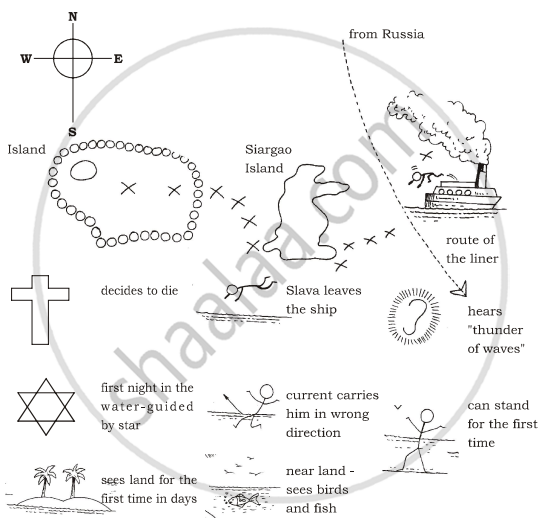
Given below is a map of the area in which Slava Kurilov faced his ordeal. You will also see the major events in the story, in mixed order, each accompanied by a symbol. After you have read ‘Ordeal in the Ocean’, draw the appropriate symbol against each x mark. (One is already drawn for you.) Draw the symbols or number the symbols, and transfer them to the map.)
Now, it is your turn. Write and produce your own radio programme. You will need to select your own content. The following are some ideas. You are free, of course, to add your own ideas. Remember, the programme must be in English.

- News stories: about people in your class, about school, about sports (school and local), about the local community
- Comedy: jokes, short plays
- Interviews: with teachers, with exstudents of your school, with a Class IX student who has recently done something very interesting
- Games: general knowledge quiz, panel game, word game
- Advertisements: for shops/industries in the local community, things ‘for sale’ and ‘wanted’ by students
- Local sites: monuments/sites of historical importance and of tourist interest
- Special reports: e.g. safety at school, examination results, school uniform, school assemblies
- Interesting people: role-play interviews with film stars, sports personalities, TV personalities, etc.
- Entertainment reviews: music, films, videos, books, etc.
- Plays
- Songs with lyrics
- Speeches on important personalities
- Tele conference video conference with students, teachers, experts
Some are Purple and gold flecked grey
For she who has journeyed through life midway,
Whose hands have cherished , whose love has blest,
And cradled fair sons on her faithful breast,
And serves her household in fruitful pride,
And worship the gods at her husband's side.
Read the lines given above and answer the question that follow:
Explain with reference to context.
We will ponder your proposition and when we decide we will let you know. But should we accept it, I here and now make this condition that we will not be denied the privilege without molestation of visiting at any time the tombs of our ancestors, friends, and children. Every part of this soil is sacred in the estimation of my people. Every hillside, every valley, every plain and grove, has been hallowed by some sad or happy event in days long vanished. Even the rocks, which seem to be dumb and dead as the swelter in the sun along the silent shore, thrill with memories of stirring events connected with the lives of my people, and the very dust upon which you now stand responds more lovingly to their footsteps than yours, because it is rich with the blood of our ancestors, and our bare feet are conscious of the sympathetic touch. Our departed braves, fond mothers, glad, happy hearted maidens, and even the little children who lived here and rejoiced here for a brief season, will love these somber solitudes and at eventide they greet shadowy returning spirits. And when the last Red Man shall have perished, and the memory of my tribe shall have become a myth among the White Men, these shores will swarm with the invisible dead of my tribe^ and when your children’s children think themselves alone in the field, the store, the shop, upon the highway, or in the silence of the pathless woods, they will not be alone. In all the earth there is no place dedicated to solitude. At night when the streets of your cities and villages are silent and you think them deserted, they will throng with the returning hosts’that once filled them and still lover this beautiful land. The White Man will never be alone.
Let him be just and deal kindly with my people, for the dead are not powerless. Dead, did I say? There is no death, only a change of worlds.
Read the extract given below and answer the question that follow.
What does the speaker say about death? Explain.
He flungs himself down in a corner to recoup from the fatigue of his visit to the shop. His wife said, “You are getting no sauce today, nor anything else. I can’t find anything to give you to eat. Fast till the evening, it’ll do you good. Take the goats and be gone now,” she cried and added, “Don’t come back before the sun is down.”
Read the extract given below and answer the question that follow.
What lie did Muni tell the shopkeeper?
Easton, with a little laugh, as if amused, was about to speak again when the other forestalled him. The glum-faced man had been watching the girl’s countenance with veiled glances from his keen, shrewd eyes.
“You’ll excuse me for speaking, miss, but, I see you’re acquainted with the marshall here. If you’ll ask him to speak a word for me when we get to the pen he’ll do it, and it’ll make things easier for me there. He’s taking me to Leavenworth prison. It’s seven years for counterfeiting.”
“Oh!” said the girl, with a deep breath and returning color. “So that is what you are doing out here? A marshal!”
“My dear Miss Fairchild,” said Easton, calmly, “I had to do something. Money has a way of taking wings unto itself, and you know it takes money to keep step with our crowd in Washington. I saw this opening in the West, and—well, a marshalship isn’t quite as high a position as that of ambassador, but—”
Read the extract given below and answer the question that follow.
Where was the prisoner being taken.
What does Canynge do soon after and what does he find? What was his reaction? What does the discovery; prove?
Answer the following question.
What are some of the signs of approaching winter referred to in the text?
Match items in List A with their meanings in List B.
Use any three of the above words in sentences of your own. You may change the form of the word
A B
wounded got up from sleep
awoke give back
forgive small patches of ground for plants
faithful severely injured
pity pardon
beds loyal
return feel sorry for
Complete the following sentences.
i. An ant is the smallest, ——————————————
ii. We know a number of facts about an ant’s life because ————————————————————
What are the changes the cricket bat has undergone with time?
What, according to the python, were the advantages of a long nose (trunk)?
What did the two friends generally talk about?
Describe the Cat and the Dad situation in the beginning and at the end of the poem.
Read the following extract from Robert Browning's poem, “The Patriot” and answer the question that follows.
|
Alack, it was I who leaped at he sun To give it my loving friends to keep! Nought man could do, have I left undone: And you see my harvest, what I reap This very day, now a year is run. |
- What can you conclude of the Patriot's mood from the given lines?
Quote the line from the given extract which tells us that the Patriot did his utmost to satisfy his people? [3] - The last line of the extract suggests that a year has gone by.
How had the speaker been treated a year ago? [3] - How did the situation change a year later? Give details of his present state. [3]
- Why were only a ‘palsied few” onlookers seated at the windows?
‘Where had the other townspeople gone?‘Why had they gone there? [3] - How is the speaker's faith in God revealed at the end of the poem?
Do you think the poem ends on a note of hope or despair? Justify your answer. [4]
