Advertisements
Advertisements
Question
With the help of a suitable example and an equation, explain the term pair production.
Advertisements
Solution
Pair Production:
When a photon passes near a massive particle like an atomic nucleus, the photon disappears by creating an electron-positron pair. This process is called pair production. The energy of the photon should be equal to the sum of energy of electron and energy position. So a photon must have an energy of at least `2m_oc^2` to create an electron-positron pair. Where `m_o` is the rest mass of an electron.
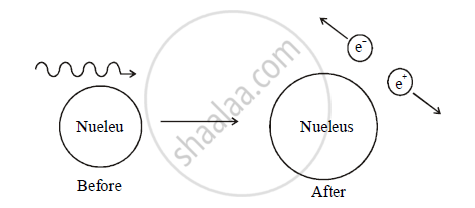
To conserve momentum, the nucleus recoils with very small velocity. Pair production is also known as the materialization of radiant energy.
APPEARS IN
RELATED QUESTIONS
Write one balanced equation to show Emission of `beta^-` (i.e. a negative beta particle)
Two nuclei have mass numbers in the ratio 1: 2. What is the ratio of their nuclear densities?
What is a neutrino?
Deuteron is a bound state of a neutron and a proton with a binding energy B = 2.2 MeV. A γ-ray of energy E is aimed at a deuteron nucleus to try to break it into a (neutron + proton) such that the n and p move in the direction of the incident γ-ray. If E = B, show that this cannot happen. Hence calculate how much bigger than B must E be for such a process to happen.
Before the neutrino hypothesis, the beta decay process was throught to be the transition, `n -> p + vece`. If this was true, show that if the neutron was at rest, the proton and electron would emerge with fixed energies and calculate them. Experimentally, the electron energy was found to have a large range.
Distinguish between isotopes and isobars.
Mass numbers of two nuclei are in the ratio of 4 : 3. Their nuclear densities will be in the ratio of ______.
Which of the following are the constituents of the nucleus?
The volume occupied by an atom is greater than the volume of the nucleus by a factor of about:
A proton or a neutron is collectively called a:
