Advertisements
Advertisements
प्रश्न
With the help of a suitable example and an equation, explain the term pair production.
Advertisements
उत्तर
Pair Production:
When a photon passes near a massive particle like an atomic nucleus, the photon disappears by creating an electron-positron pair. This process is called pair production. The energy of the photon should be equal to the sum of energy of electron and energy position. So a photon must have an energy of at least `2m_oc^2` to create an electron-positron pair. Where `m_o` is the rest mass of an electron.
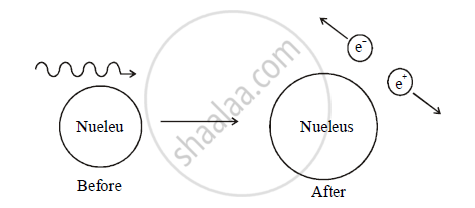
To conserve momentum, the nucleus recoils with very small velocity. Pair production is also known as the materialization of radiant energy.
APPEARS IN
संबंधित प्रश्न
A nucleus with mass number A = 240 and BE/A = 7.6 MeV breaks into two fragments, each of A = 120 with BE/A = 8.5 MeV. Calculate the released energy.
In the study of Geiger-Marsdon experiment on scattering of α particles by a thin foil of gold, draw the trajectory of α-particles in the coulomb field of target nucleus. Explain briefly how one gets the information on the size of the nucleus from this study.
From the relation R = R0 A1/3, where R0 is constant and A is the mass number of the nucleus, show that nuclear matter density is independent of A
Boron has two stable isotopes, `""_5^10"B"` and `""_5^11"B"`. Their respective masses are 10.01294 u and 11.00931 u, and the atomic mass of boron is 10.811 u. Find the abundances of `""_5^10"B"` and `""_5^11"B"`.
What is a neutrino?
\[\ce{^197_79Au}\] contains ______.
A nucleus of mass number A has a radius R such that ______.
Two cars of mass m1 and m2 are moving in circles of radii r1 and r2, respectively. Their speeds are such that they make complete circles at the same time t. The ratio of their centripetal acceleration is:
Before the neutrino hypothesis, the beta decay process was throught to be the transition, `n -> p + vece`. If this was true, show that if the neutron was at rest, the proton and electron would emerge with fixed energies and calculate them. Experimentally, the electron energy was found to have a large range.
The value of one atomic mass unit (1 u) is:
Atomic species of the same element differing in mass are called:
