Advertisements
Advertisements
प्रश्न
With the help of a suitable example and an equation, explain the term pair production.
Advertisements
उत्तर
Pair Production:
When a photon passes near a massive particle like an atomic nucleus, the photon disappears by creating an electron-positron pair. This process is called pair production. The energy of the photon should be equal to the sum of energy of electron and energy position. So a photon must have an energy of at least `2m_oc^2` to create an electron-positron pair. Where `m_o` is the rest mass of an electron.
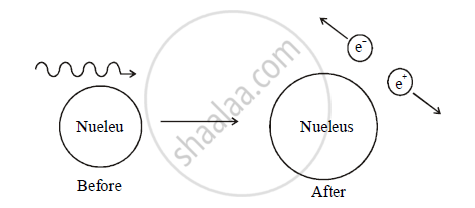
To conserve momentum, the nucleus recoils with very small velocity. Pair production is also known as the materialization of radiant energy.
APPEARS IN
संबंधित प्रश्न
A nucleus with mass number A = 240 and BE/A = 7.6 MeV breaks into two fragments, each of A = 120 with BE/A = 8.5 MeV. Calculate the released energy.
Obtain approximately the ratio of the nuclear radii of the gold isotope `""_97^197 "Au"` and the silver isotope `""_47^197"Ag"`.
The mass number of a nucleus is equal to the number of:-
Are the nucleons fundamental particles, or do they consist of still smaller parts? One way to find out is to probe a nucleon just as Rutherford probed an atom. What should be the kinetic energy of an electron for it to be able to probe a nucleon? Assume the diameter of a nucleon to be approximately 10–15 m.
Distinguish between isotopes and isobars.
Two nuclei have different mass numbers A1 and A2. Are these nuclei necessarily the isotopes of the same element? Explain.
What conclusion is drawn from Rutherford’s scattering experiment of α-particles?
The relation between the mass number A, atomic number Z, and neutron number N of a nuclide is:
The number of protons in the nucleus is equal to:
Regarding the stability of the neutron, which statement is correct?
