Advertisements
Advertisements
Questions
With the help of a labelled diagram, show that the balancing condition of a Wheatstone bridge is
`R_1/R_2 = R_3/R_4` where the terms have their usual meaning.
Obtain the balancing condition in the case of Wheatstone’s network.
Advertisements
Solution
Four resistances P, Q, R and S are connected to form a quadrilateral ABCD as shown in the following figure. A battery of emf ε along with a key, is connected between points A and C such that point A is at higher potential with respect to point C. A galvanometer of internal resistance G is connected between points B and D.

When the key is closed, current I flows through the circuit. It divides into I1 and I2 at point A. I1 is the current through P, and I2 is the current through S. The current I1 gets divided at point B. Let Ig be the current flowing through the galvanometer. The currents flowing through Q and R are respectively (I1 – Ig) and (I2 + Ig),
I = I1 + I2 ...(1)
Consider the loop ABDA. Applying Kirchhoff’s voltage law in the clockwise sense shown in the loop, we get
–I1P – IgG + I2S = 0 ...(2)
Applying Kirchhoff's voltage law to loop BCDB in a clockwise sense, we get,
–(I1 – Ig)Q + (I2 + Ig)R + IgG = 0 .....(3)
From these three equations (Eq. (1), (2), (3), we can find the current flowing through any branch of the circuit.
A special case occurs when the current passing through the galvanometer is zero. In this case, the bridge is said to be balanced. The condition for the balance is Ig = 0. This condition can be obtained by adjusting the values of P, Q, R and S. Substituting Ig = 0 in Eq. (2) and Eq. (3) we get,
–I1P + I2S = 0 ∴ I1P = I2S ...(4)
–I1Q + I2R = 0 ∴ I1Q = I2R ...(5)
Dividing Eq. (4) by Eq. (5), we get
`∴ (I_1 P)/(I_1 Q) = (I_1 S)/(I_2 R)`
`therefore P/Q = S/R`
APPEARS IN
RELATED QUESTIONS
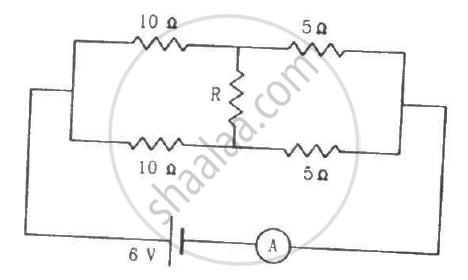
What should be the value of R in the figure for which the current in it is zero?
In a meter bridge, two unknown resistances R and S, when connected between the two gaps, give a null point is 60 cm from one end. What is the ratio of R and S?
Explain with a neat circuit diagram. How you will determine the unknown resistances using a meter bridge.
In a meter bridge, the balance point is found to be at 39.5 cm from the end A when the resistor R is 12.5 Ω (right gap).
a) Determine the resistance of X (left gap).
b) Determine the balance point of the bridge if X and R are interchanged?
c) What happens if the galvanometer and cell are interchanged at the balance point of the bridge?
In conversion of moving coil galvanometer into an ammeter of required range, the resistance of ammeter, so formed is ______.
[S = shunt and G = resistance of galvanometer]
The current which flows in a galvanometer of Wheatstone bridge is directly proportional to ______
In a metre bridge experiment, the null point is obtained at 20 cm from one end of the wire when resistance X is balanced against another resistance Y. If X < Y, then where will be the new position of the null point from the same end, if one decides to balance a resistance of 4X against Y?
In the circuit shown, a metre bridge is in its balanced state. The metre bridge wire has a resistance 0.1 ohm/cm. The value of unknown resistance X and the current drawn from the battery of negligible resistance are ____________.

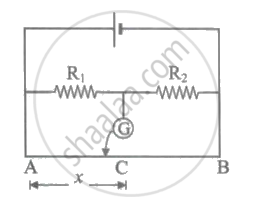
In the metre bridge experiment shown in the figure, the balance length AC corresponding to null deflection of the galvanometer is x. What would be the balance length if the radius of the wire AB is doubled?
In Wheatstone's network p = 2 `Omega` , Q = 2 `Omega`, R = 2 `Omega` and S = 3 `Omega`. The resistance with which S is to be shunted in order that the bridge may be balanced is ______.
The resistances in left and right gap of a metrebridge are 20 `Omega` and 30 `Omega` respectively. When the resistance in the left gap is reduced to half its value, the balance point shifts by ______.
In the Wheatstone bridge, (shown in the figure) X = Y and A > B. The direction of the current between a and b will be ____________.

What is the e.m.f of the cell C in the circuit shown in figure, if the deflection in the galvanometer is zero, the resistance of the wire is 3 `Omega`, The length of the wire is 100 cm?

A resistance of 5 `Omega` is connected in the left gap of a metre bridge and 15 `Omega` in the other gap. The position of the balancing point is ____________.
In following figure, a current of 1.4 A flows towards the bridge circuit. The current in 2 n resistor is ______.
Which among the following resistances can be determined by a metre bridge?
In a meter bridge experiment, to minimize an error due to contact resistance, ______
In a Wheatstone's bridge, the resistance in the three arms are P, Q, R, and its fourth arm has a parallel combination of two resistances S1 and S2, The balancing condition of the bridge is ______
A resistance of 20 Ω is connected in the left gap of a meter bridge and an unknown resistance greater than 20 Ω is connected in the right gap. When these resistances are interchanged, the balance point shifts by 20 cm. The unknown resistance is ______.
Draw a neat labelled diagram to determine unknown resistance using a meter bridge.
Find the radius of the wire of length 25m needed to prepare a coil of resistance 25Ω. (Resistivity of material of wire is 3.142 x 10⁻⁷Ωm)
Four resistances 4Ω, 4Ω, 4Ω and 12Ω form a Wheatstone's network. Find the resistance which when connected across the 12Ω resistance will balance the network.
Write balancing condition of a Wheatstone bridge.
The current passing through the battery in the given circuit is:
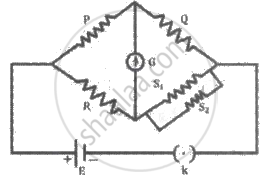
In a Wheatstone’s bridge, three resistances P, Q and R connected in the three arms and the fourth arm is formed by two resistances S1 and S2 connected in parallel. The condition for the bridge to be balanced will be ______.
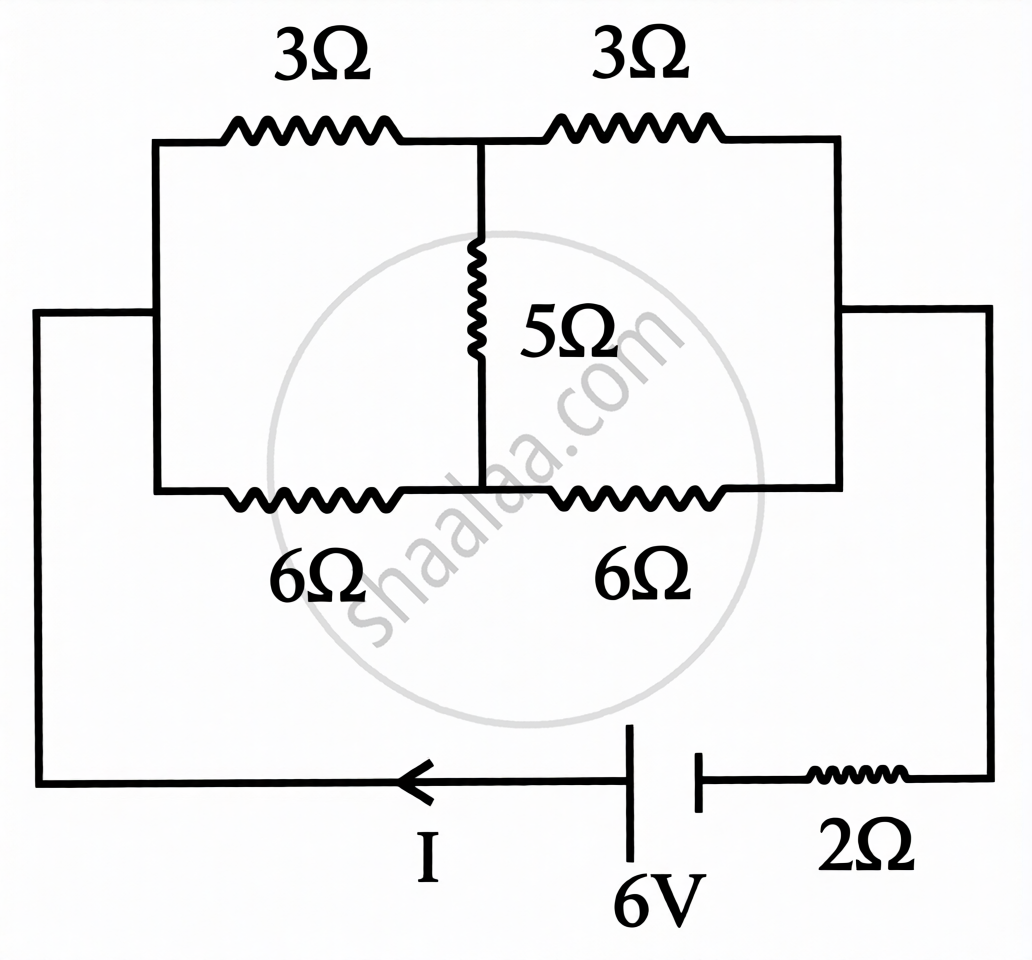
A battery of 6 V is connected to the circuit as shown below. The current I drawn from the battery is: