Advertisements
Advertisements
Questions
Why is pure acetic acid also known as glacial acetic acid?
Why is pure acetic acid called glacial acetic acid?
Advertisements
Solution
Acetic acid that contains a very low amount of water (less than 1%) is called anhydrous (water-free) acetic acid or glacial acetic acid. The reason it’s called glacial is because it solidifies into solid acetic acid crystals just cooler than room temperature at 16.7°C, which is ice. Removing the water from acetic acid lowers its melting point by 0.2°C.
APPEARS IN
RELATED QUESTIONS
In an experiment to study the properties of ethanoic acid, a student takes about 3 mL of ethanoic acid in a dry test tube. He adds an equal amount of distilled water to it and shakes the test tube well. After some time he is likely to observe that
(A) a colloid is formed in the test tube.
(B) the ethanoic acid dissolves readily in water.
(C) the solution becomes light orange.
(D) water floats over the surface of ethanoic acid.
List two uses of esters.
Identify the term or substance based on the descriptions given below
Ice like crystals formed on cooling an organic acid sufficiently.
What is the common name of methanol?
Vinegar is a solution of about:
(a) 5 to 8 per cent ethanoic acid in alcohol
(b) 5 to 8 per cent ethanoic acid in water
(c) 50 to 80 per cent ethanoic acid in water
(d) 50 to 80 per cent ethanoic acid in alcohol
A student takes 2 mL acetic acid in a dry test tube and adds a pinch of sodium hydrogen carbonate to it. He makes the following observations:
I. A colourless and odourless gas evolves with a brisk effervescence.
II. The gas turns lime water milky when passed through it.
III. The gas burns with an explosion when a burning splinter is brought near it.
IV. The gas extinguishes the burning splinter that is brought near it.
The correct observations are:
(A) I, II, and III
(B) II, III and IV
(C) III, IV and I
(D) IV, I and II
Write a balanced chemical equation for the following:
A mixture of sodalime and sodium acetate is heated.
Observe the figure and write the answers to the following questions.
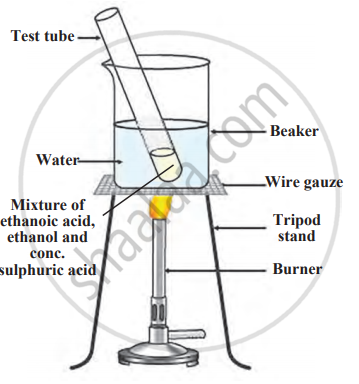
- Write the name of the reaction shown in the following figure.
- Write the above chemical reaction in the form of a balanced equation.
- Write the name of the product produced in the above reaction, write a use.
- Write the name of the catalyst used in the above reaction.
Observe the diagram given below and answer the questions:

- Name the reactants in this reaction.
- Which gas comes out as effervescence in the bigger test tube?
- What is the colour change in the lime water?
- In the above experiment instead of sodium carbonate which chemical can be used to get same products?
- Write the use of acetic acid.
Give the balanced chemical equation of the following reaction:
Neutralization of NaOH with ethanoic acid.
