Advertisements
Advertisements
Question
Why did Hari Singh smile in his most appealing way towards the end of the story?
Advertisements
Solution
Towards the close of the story, Hari Singh's most appealing smile is full of gratitude, devoid of guile, dishonesty, or selfishness. It effortlessly radiates sincerity, serving as his expression of thankfulness towards Anil's magnanimity. Despite Hari Singh's attempt to rob Anil, the latter chooses to retain him as his domestic help. This genuine smile reflects Hari Singh's appreciation for Anil's kindness and understanding, acknowledging the second chance he has been given.
APPEARS IN
RELATED QUESTIONS
Who does ‘I’ refer to in this story?
What does he get from Anil in return for his work?
How does the thief think Anil will react to the theft?
What are Hari Singh’s reactions to the prospect of receiving an education? Do they change over time? (Hint: compare, for example, the thought: “I knew that once I could write like an educated man there would be no limit to what I could achieve” with these later thoughts: ‘Whole sentences, I knew, cloud one day bring me more than a few hundred rupees. It was a simple matter to steal − and sometimes just as simple to be caught. But to be a really big man, a clever and respected man, was something else.”) What makes him return to Anil?
Why does not Anil hand the thief over to the police? Do you think most people would have done so? In what ways is Anil different from such employers?
Read the following passage and do the activities:
A1. Choose the correct alternatives from the given options and rewrite the sentences :
(appealing, casually, flattery, well-oiled) (2)
(1) I followed ….........
(2) Anil talked about the ….........wrestlers.
(3) I gave him my most ….........smile.
(4) A little …......... helps in making friends.
I was still a thief when 1 met Anil. And though only 15, was an experienced and fairly successful hand.
Anil was watching a wrestling match when I approached him. He was about 25 — a tall, lean fellow — and he looked easy-going, kind and simple enough for my purpose. I hadn’t had much luck of late and thought I might be able to get into the young man’s confidence.
“You look a bit of a wrestler yourself,” I said. A little flattery helps in making friends.
“So do you,” he replied, which put me off for a moment because at that time I was rather thin.
“Well, I said modestly, “I do wrestle a bit.”
“What's your name ?”
“Hari Singh,” I lied. I took a new name every month. That kept me ahead of the police and my former employers.
After this introduction, Anil talked about the well-oiled wrestlers who were grunting, lifting and throwing each other about. I didn't have much to say. Anil walked away. I followed casually.
“Hello again,” he said.
I gave him my most appealing smile. “I want to work for you”. I said.
“But I can't pay you.”
I thought that over for a minute. Perhaps I had misjudged my man. I asked, “Can you feed me ?”
“Can you cook ?”
“I can cook,” I lied again.
“If you can cook, then may be I can feed you.”
He took me to his room over the Jumna Sweet Shop and told me I could sleep on the balcony. But the meal I cooked that night must have been terrible because Anil gave it to a stray dog and told me to be off. But I just hung around, smiling in my most appealing way, and he couldn’t help laughing.
A2. Complete the following web-chart: (2)

A3. Find the similar meaning words from the passage for the following : (2)
(1) endearing
(2) miscalculated
(3) humbly
(4) awful
A4.
(1) “I want to work for you,” I said. (1)
(Change it into indirect speech)
(2) I can’t pay you. (1)
(Rewrite making it affirmative)
A5. “We should learn from our own mistakes.” Explain. (2)
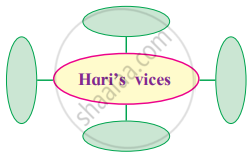
Complete the web diagram.
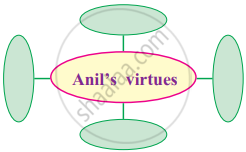
Complete the web diagram.
Pick out from the story 3 or 4 examples of Code-mixing (Indian words used in English).
Read the story carefully and complete the table:
| Total no. of characters | Names | Age | Physical appearance | Earned money by | Qualities |
| ......... | ......... | ........... | ........... | ........... | |
| ......... | ......... | ........... | ........... | ........... |
Anil didn’t hand Hari over to the police ______
The moral of the story is ______
Think and write in your own words in your notebook.
Why did Anil employ Hari as a cook, although he could not afford to pay him?
Think and write in your own words in your notebook.
What did Hari learn from Anil in the beginning?
Read the following passage and do the activities.
|
I was still a thief when I met Anil. And though only 15, I was an experienced and fairly successful hand. Anil was watching a wrestling match when I approached him. He was about 25- a tall, lean fellow - and he looked easy-going, kind and simple enough for my purpose. I hadn't had much luck of late and thought I might be able to get into the young man's confidence. "You look a bit of a wrestler yourself," I said. A little flattery helps in making friends. "So do you," he replied, which put me off for a moment because at that time I was rather thin. "Well," I said modestly, "I do wrestle a bit." "What's your name ?" "Harl Singh," I lied. I took a new name every month. That kept me ahead of the police and my former employers. After this introduction, Anil talked about the well-oiled wrestlers who were grunting, lifting and throwing each other about. I didn't have much to say. Anil walked away. I followed casually. "Hello again," he said. I gave him my most appealing smile. "I want to work for you." I said. "But I can't pay you." I thought that over for a minute. Perhaps I had misjudged my man. I asked, "Can you feed me ?" "Can you cook?" "I can cook," I lied again. "If you can cook, then may be I can feed you." |
A1. Complete the given boxes with who said to whom: (2)
| Statement | Who | To whom | |
| (i) | You look a bit of a wrestler yourself. | ||
| (ii) | If you can cook, then may be I can feed you. |
A2. Complete the cluster diagram mentioning the characteristics of the main character of the passage: (2)

A3. Choose the correct meanings of the following words from the given options: (2)
- Flattery -
- insincere praise
- appreciation
- creating false impression
- unfaithful behaviour
- Appealing -
- good conduct
- attractive
- charming
- beautiful
A4. Do as directed: (2)
- I took a new name every month.
[Frame 'Wh' question to get the underlined part as an answer.] - I was an experienced hand.
[Underline the determiners from the given sentence.]
A5. Why do you think Hari Singh gave his most appealing smile? (2)
Read the following passage and do the activities.
A1. Relate the following qualities with the two characters of the story:
 |
 |
 |
 |
| Narrator | Anil | |
| (1) | ||
| (2) |
| He took to his room over the Jumna Sweet shop and told me I could sleep on the balcony. But the meal I cooked that night must have been terrible because Anil gave it to a stray dog and told me to be off. But I just hung around, smiling in my most appealing way, and he couldn't help laughing. Later, he patted me on the head and said never mind, he'd teach me to cook. He also taught me to write my name and said he would soon teach me to write whole sentences and add numbers. I was grateful. I knew that once I could write like an educated man there would be no limit to what I could achieve. It was quite pleasant working for Anil. I made the tea in the morning and then would take my time buying the day's supplies, usually making a profit of about a rupee a day. I think he knew I made a little money this way but he did not seem to mind. Anil made money by fits and starts. He would borrow one week, and lend the next. He kept worrying about his next cheque, but as soon as it arrived he would go out and celebrate. It seems he wrote for magazines a queer way to make a living! One evening he came home with a small bundle of notes, saying he had just sold a book to a publisher. At night, I saw him tuck the money under the mattress. |
A2. State whether true or false:
- Anil liked what the narrator cooked.
- Anil taught the narrator to write his name.
- Anil was a wealthy person.
- Anil made money by fits and starts.
A3. Match the words to their meanings.
| (1) Pleasant | Strange |
| (2) Fits and starts | Satisfactory |
| (3) Queer | Give |
| (4) Lend | Irregular bursts of activities |
A4. Do as directed:
Frame 'Wh' questions with reference to the phrases underlined below. (Change the first person pronouns to second person)
- He taught me to write my name.
- I think he knew I made a little money this way but he did not seem to mind.
A5. Give a brief description of Anil and the narrator's characters.
Fiction writers prefer creating grey characters rather than black and white. Analyse this in detail, with reference to both the characters of The Thief’s Story.
Imagine that Hari Singh from ‘The Thief’s Story’ by Ruskin Bond, writes a diary entry, exploring the theme of human values and relations that are essential in life and can transform a person in the context of his own experience. Write this diary entry as Hari Singh.
