Advertisements
Advertisements
Question
Why are the ceilings of concert halls curved?
Advertisements
Solution
Generally, the ceilings of concert halls, are curved so that sound after reflection reaches all corners of the hall. Sometimes a curved sound board may be placed behind the stage so that the sound, after reflecting from the soundboard, spreads evenly across the width of the hall.
RELATED QUESTIONS
The following diagram shows three ways in which the string of an instrument can vibrate.
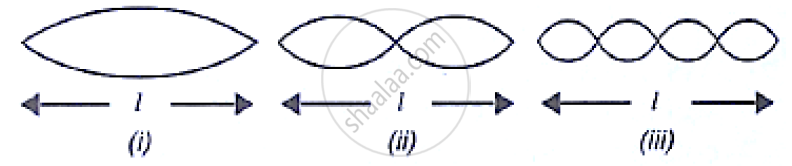
(a) which of the diagram shows the principal note?
(b) which has the frequency four times that of the first?
(c) what is the ratio of the frequency of the vibration in (i) and (ii)?
Explain how the principle of echo is used by the bat during its flight at night.
Define the term Frequency (as applied to sound waves)
Point out the waves from the given list, i.e., light, sound, radio waves, ultrasonic waves, and thermal radiation, the energy is propagated by mechanical waves.
Write the approximate value of the speed of sound in air.
Waves produced on the surface of the water are formed to move with a velocity of 24 ms−1. If the wavelength of these waves equals 20 cm. find the
(i) frequency (no. of waves produced per second)
(ii) the time period (i.e. the time required to produce one wave) for these waves.
Explain Reflection at curved surfaces.
A sound wave whose frequency is 5000 Hz travels in air and then hits the water surface. The ratio of its wavelengths in water and air is ______.
Match the following:
| 1. | Stethoscope | a. | Repeated reflections |
| 2. | Echogram | b. | Multiple reflections |
| 3. | SONAR | c. | Ultrasonic waves |
| 4. | Reverberation | d. | Speed of underwater objects |
