Advertisements
Advertisements
Question
Which product is formed when the compound  is treated with concentrated aqueous \[\ce{KOH}\] solution?
Options
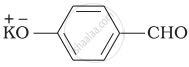

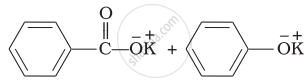
Advertisements
Solution

Explanation:
Benzaldehyde is having no a hydrogen. So, on reaction with aqueous KOH solution, it undergoes Cannizzaro’s reaction. One molecule of aldehyde is reduced and other is
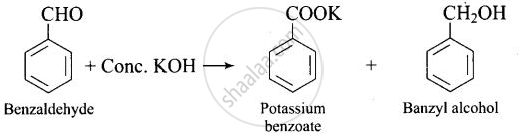
APPEARS IN
RELATED QUESTIONS
How will you convert ethanal into the following compound?
Butane-1, 3-diol
Write structural formulas and names of four possible aldol condensation products from propanal and butanal. In each case, indicate which aldehyde acts as nucleophile and which as electrophile.
How will you bring about the following conversion in not more than two steps?
Benzaldehyde to 3-Phenylpropan-1-ol
Give reasons Acetylation of aniline reduces its activation effect.
Why is alpha (α) hydrogen of carbonyl compounds acidic in nature?
Write chemical equations of the following reaction :
Propanone is treated with dilute Ba (OH)2-.
What is substituted imine called?
Which of the following compounds do not undergo aldol condensation?
(i) \[\ce{CH3 - CHO}\]
(ii) 
(iii) \[\begin{array}{cc}
\phantom{}\ce{O}\\
\phantom{}||\\
\ce{CH3 - C - CH3}
\end{array}\]
(iv) \[\begin{array}{cc}
\phantom{}\ce{CH3}\\
|\phantom{...}\\
\ce{CH3 - C - CHO}\phantom{..}\\
|\phantom{...}\\
\phantom{}\ce{CH3}\\
\end{array}\]
Why is there a large difference in the boiling points of butanal and butan-1-ol?
What product will be formed on reaction of propanal with 2-methylpropanal in the presence of \[\ce{NaOH}\]? What products will be formed? Write the name of the reaction also.
Assertion: The α-hydrogen atom in carbonyl compounds is less acidic.
Reason: The anion formed after the loss of α-hydrogen atom is resonance stabilised.
Give reasons to support the answer:
Presence of Alpha hydrogen in aldehydes and ketones is essential for aldol condensation.
Which of the following gives aldol con~ensation reaction?
Predict the reagent for carrying out the following transformations:
Ethanal to 3-hydroxy butanal
Which of the following does not give aldol condensation reaction?
Why is the α-hydrogens of aldehydes and ketones are acidic in nature?
When acetaldehyde is treated with dilute NaOH, the following reaction is observed.
\[\begin{array}{cc}
\ce{2CH3 - CHO ->[dil.NaOH] CH3 - CH - CH2 - CHO}\\
\phantom{...............}|\\
\phantom{.................}\ce{OH}
\end{array}\]
- What are the functional groups in the product?
- Can another product be formed during the same reaction? (Deduce the answer by doing atomic audit of reactant and product).
- Is this an addition reaction or condensation reaction?
Write a note on the aldol condensation reaction of acetaldehyde.
