Advertisements
Advertisements
Question
Which of the following are purine bases?
(i) Guanine
(ii) Adenine
(iii) Thymine
(iv) Uracil
Advertisements
Solution
(i) Guanine
(ii) Adenine
Explanation:
Purines consist of six-membered and five-membered nitrogen-containing ring fused together.
Guanine and adenine are purine bases whose structures are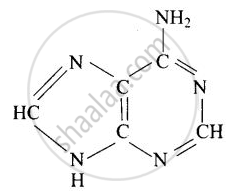
Adenine (A)
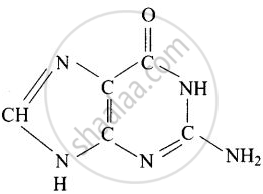
Guanine (G)
While thymine and uracil are pyrimidine bases.
APPEARS IN
RELATED QUESTIONS
Define the following as related to proteins:
Peptide linkage
The protein responsible for blood clotting is ____________.
The correct statement for protein haemoglobin.
Which functional group participates in disulphide bond formation in proteins?
Which of the following statement is correct:
Proteins are found to have two different types of secondary structures viz. α-helix and β-pleated sheet structure. α-helix structure of protein is stabilised by:
Proteins can be classified into two types on the basis of their molecular shape i.e., fibrous proteins and globular proteins. Examples of globular proteins are:
(i) Insulin
(ii) Keratin
(iii) Albumin
(iv) Myosin
In fibrous proteins, polypeptide chains are held together by:
(i) van der Waals forces
(ii) disulphide linkage
(iii) electrostatic forces of attraction
(iv) hydrogen bonds
α-Helix is a secondary structure of proteins formed by twisting of polypeptide chain into right-handed screw like structures. Which type of interactions are responsible for making the α-helix structure stable?
Peptide linkage is:
Explain formation of peptide linkage in protein with an example.
Given below are two statements labelled as Assertion (A) and Reason (R).
Assertion (A): Proteins are found to have two different types of secondary structures viz alpha-helix and beta-pleated sheet structure.
Reason (R): The secondary structure of proteins is stabilized by hydrogen bonding.
Select the most appropriate answer from the options given below:
Presence of disulphide link gives rise to which structure of protein?
Out of the following, which type of interaction is responsible for the stabilisation of the α-helix structure of proteins?
Proteins are polymers of ______.
Assertion (A): Proteins are polymers of α-amino acids connected by a peptide bond.
Reason (R): A tetrapeptide contains 4 amino acids linked by 4 peptide bonds.
Statement I: A protein is imagined as a line, the left end represented by first amino acid (C-terminal) and the right end represented by last amino acid (Nterminal).
Statement II: Adult human haemoglobin, consists of 4 subunits (two subunits of a type and two subunits β type.)
In the light of the above statements, choose the correct answer from the options given below:
