Advertisements
Advertisements
Question
Define the following as related to proteins:
Peptide linkage
Advertisements
Solution
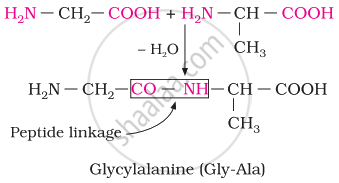
Chemically, peptide linkage is an amide formed between the –COOH group and –NH2 group. The reaction between two molecules of similar or different amino acids proceeds through the combination of the amino group of one molecule with the carboxyl group of the other. This results in the elimination of a water molecule and the formation of a peptide bond –CO–NH–. The product of the reaction is called a dipeptide because it is made up of two amino acids.
For example, when the carboxyl group of glycine combines with the amino group of alanine, we get a dipeptide, glycylalanine.
APPEARS IN
RELATED QUESTIONS
What is peptide linkage?
The helical structure of protein is stabilized by:
Which functional group participates in disulphide bond formation in proteins?
Which of the following statement is correct:
Proteins are found to have two different types of secondary structures viz. α-helix and β-pleated sheet structure. α-helix structure of protein is stabilised by:
Optical rotations of some compounds along with their structures are given below which of them have D configuration.
| (I) |  |
| (II) |  |
| (III) |  |
Proteins can be classified into two types on the basis of their molecular shape i.e., fibrous proteins and globular proteins. Examples of globular proteins are:
(i) Insulin
(ii) Keratin
(iii) Albumin
(iv) Myosin
Which of the following are purine bases?
(i) Guanine
(ii) Adenine
(iii) Thymine
(iv) Uracil
α-Helix is a secondary structure of proteins formed by twisting of polypeptide chain into right-handed screw like structures. Which type of interactions are responsible for making the α-helix structure stable?
Which moieties of nucleosides are involved in the formation of phosphodiester linkages present in dinucleotides? What does the word diester in the name of linkage indicate? Which acid is involved in the formation of this linkage?
Assertion: β-glycosidic linkage is present in maltose,

Reason: Maltose is composed of two glucose units in which C–1 of one glucose unit is linked to C–4 of another glucose unit.
Peptide linkage is:
Presence of disulphide link gives rise to which structure of protein?
Out of the following, which type of interaction is responsible for the stabilisation of the α-helix structure of proteins?
The correct structure of Ruhemann's Purple, the compound formed in the reaction of ninhydrin with proteins is:
The total number of negative charge in the tetrapeptide, Gly-Glu-Asp-Tyr at pH 12.5 will be ______. (Integer answers)
What is the effect of denaturation on the structure of proteins?
Write a classification of proteins with an example.
Statement I: A protein is imagined as a line, the left end represented by first amino acid (C-terminal) and the right end represented by last amino acid (Nterminal).
Statement II: Adult human haemoglobin, consists of 4 subunits (two subunits of a type and two subunits β type.)
In the light of the above statements, choose the correct answer from the options given below:
