Advertisements
Advertisements
Question
Where can a body execute free vibrations?
Advertisements
Solution
The free vibrations of a body actually occur only in the vacuum because the presence of a medium offers some resistance due to which the amplitude of vibration does not remain constant and decreases continuously.
Thus, we define free vibrations as the periodic vibrations of a body of constant amplitude in the absence of any external force on it.
APPEARS IN
RELATED QUESTIONS
Moment of force =............... × distance of force from the point of turning.
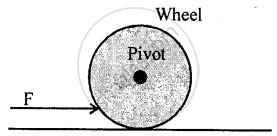
State the effect of force F in of the following diagram.
The hand flour grinder is provided with a handle near the rim.
What is thrust?
Write an expression for the change in momentum of a body of mass m moving with velocity v if v << c.
Explain the motion of a planet around the sun in a circular path.
State whether the moment of force is a scalar or vector quantity?
Two unlike forces (parallel) of 10 N and 25 N act at a distance of 12 cm. from each other. Find the point about which the body balance.
On a see-saw, two children of masses 30 kg and 50 kg are sitting on one side of it at distance 2 m and 2.5 m respectively, from its middle, where should a man of mass 74 kg sit to balance it?
