Advertisements
Advertisements
Question
What type of wavefront will emerge from a (i) point source, and (ii) distance light source?
Advertisements
Solution
(i) For point source, wavefront will be spherical.
(ii) For a distannt light source, the wavefronts will be plane wavefronts.
APPEARS IN
RELATED QUESTIONS
The equation of refraction at a spherical surface is \[\frac{\mu_2}{\nu} - \frac{\mu_1}{\mu} = \frac{\mu_2 - \mu_1}{R}\]
Taking \[R = \infty\] show that this equation leads to the equation
\[\frac{\text{ Real depth }}{\text{ Apparent depth }} = \frac{\mu_2}{\mu_1}\]
for refraction at a plane surface.
A converging lens of focal length 15 cm and a converging mirror of focal length 10 cm are placed 50 cm apart with common principal axis. A point source is placed in between the lens and the mirror at a distance of 40 cm from the lens. Find the locations of the two images formed.
Use the above relation to obtain the condition on the position of the object and the radius of curvature in terms of n1and n2 when the real image is formed.
Define the term ‘focal length of a mirror’.
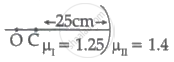
Region I and II are separated by a spherical surface of a radius of 25 cm. An object is kept in the region I at a distance of 40 cm from the surface. The distance of the image from the surface is ______.
A spherical surface of radius R separates two medium of refractive indices µ1 and µ2, as shown in figure. Where should an object be placed in the medium 1 so that a real image is formed in medium 2 at the same distance?

Obtain an expression for refraction at a single convex spherical surface, i.e., the relation between μ1 (rarer medium), μ2 (denser medium), object distance u, image distance v and the radius of curvature R.
Assertion: If critical angle of glass-air pair `("μg" = 3/2)` is θ1 and that of water-air pair `("μw" = 4/3)` is θ2, then the critical angle for the water-glass pair will lie between θ1 and θ2.
Reason: A medium is optically denser if its refractive index is greater.
In the geometrical setup for refraction at a spherical surface, the centre of curvature, object distance, image distance, and radius of curvature are denoted respectively by:
When a light ray strikes a curved surface and refracts, the amount of bending depends on:
