Two Convex Lenses, Each of Focal Length 10 Cm, Are Placed at a Separation of 15 Cm with Their Principal Axes Coinciding. (A) Show that a Light Beam Coming Parallel to the Principal Axis Diverges
Advertisements
Question
Two convex lenses, each of focal length 10 cm, are placed at a separation of 15 cm with their principal axes coinciding. (a) Show that a light beam coming parallel to the principal axis diverges as it comes out of the lens system. (b) Find the location of the virtual image formed by the lens system of an object placed far away. (c) Find the focal length of the equivalent lens. (Note that the sign of the focal length is positive although the lens system actually diverges a parallel beam incident on it.)
Advertisements
Solution
Given,
Focal length of each convex lens, f = 10 cm
Distance between both the lens, d = 15 cm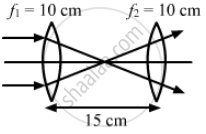
(a) As shown in the figure, the light rays are falling parallel to the principal axis of the first lens, therefore the rays will converge within the focal length of the second lens. Hence, all the rays emerging from the lens system are diverging.
(b) Using lens formula for first convex lens,
\[\frac{1}{v} = \frac{1}{f} + \frac{1}{u} \]
\[ \Rightarrow \frac{1}{v}=\frac{1}{10}+\frac{1}{( - \infty )}\]
\[ \Rightarrow \frac{1}{v}=\frac{1}{10}\]
\[ \Rightarrow v = 10 \text{ cm }\]
For the second convex lens,
Object distance, u = −(15 − 10) = −5 cm
If v1 is the image distance for the second convex lens, then,
Applying lens formula we have:
\[\frac{1}{v_1} = \frac{1}{f} + \frac{1}{u}\]
\[\Rightarrow \frac{1}{v_1} = \frac{1}{10} + \frac{1}{- 5} \]
\[ \Rightarrow \frac{1}{v_1} = \frac{- 1}{10}\]
\[ \Rightarrow v_1 = - 10 cm\]
Thus, the virtual image of the object will be at 5 cm from the first convex lens.
(c) The equivalent focal length of the lens system
\[\left( F \right)\] is given by,
\[\frac{1}{F} = \frac{1}{f_1} + \frac{1}{f_2} - \frac{d}{f_1 f_2}\]
\[Here, f = f_1 = f_2 = 10 \text{ cm }\]
\[ \therefore \frac{1}{F} = \frac{1}{10} + \frac{1}{10} - \frac{15}{100}\]
\[ \Rightarrow \frac{1}{F} = \frac{5}{100}\]
\[ \Rightarrow F = 20 \text{ cm }\]
Therefore the equivalent focal length (F) is 20 cm...
APPEARS IN
RELATED QUESTIONS
A convex lens has a focal length of 10 cm. Find the location and nature of the image if a point object is placed on the principal axis at a distance of (a) 9.8 cm, (b) 10.2 cm from the lens.
An extended object is placed at a distance of 5.0 cm from a convex lens of focal length 8.0 cm. (a) Draw the ray diagram (to the scale) to locate the image and from this, measure the distance of the image from the lens. (b) Find the position of the image from the lens formula and see how close the drawing is to the correct result.
A converging lens of focal length 15 cm and a converging mirror of focal length 10 cm are placed 50 cm apart with common principal axis. A point source is placed in between the lens and the mirror at a distance of 40 cm from the lens. Find the locations of the two images formed.
A point object is placed at a distance of 15 cm from a convex lens. The image is formed on the other side at a distance of 30 cm from the lens. When a concave lens is placed in contact with the convex lens, the image shifts away further by 30 cm. Calculate the focal lengths of the two lenses.
Use the above relation to obtain the condition on the position of the object and the radius of curvature in terms of n1and n2 when the real image is formed.
Define the term ‘focal length of a mirror’.
Region I and II are separated by a spherical surface of a radius of 25 cm. An object is kept in the region I at a distance of 40 cm from the surface. The distance of the image from the surface is ______.
Define the critical angle for a given pair of media and total internal reflection. Obtain the relation between the critical angle and refractive index of the medium.
A point object in the air is placed symmetrically at a distance of 60 cm in front of a concave spherical surface with a refractive index of 1.5. If the radius of curvature of the surface is 20 cm, find the position of the image formed.
Assertion: If critical angle of glass-air pair `("μg" = 3/2)` is θ1 and that of water-air pair `("μw" = 4/3)` is θ2, then the critical angle for the water-glass pair will lie between θ1 and θ2.
Reason: A medium is optically denser if its refractive index is greater.
According to the Cartesian sign convention for refraction at a spherical surface, all distances are measured from:
In the Cartesian sign convention, distances measured in the direction of incident light are taken as:
When light goes from a denser to a rarer medium at a spherical surface, the refracted ray:
In the derivation of the spherical surface refraction formula, which approximation is applied to the angles made by the incident ray, refracted ray, and normal?
Which effect is common for image shift in refraction at a plane surface?
In the geometrical setup for refraction at a spherical surface, the centre of curvature, object distance, image distance, and radius of curvature are denoted respectively by:
