Advertisements
Advertisements
Question
A ball is kept at a height h above the surface of a heavy transparent sphere made of a material of refractive index μ. The radius of the sphere is R. At t = 0, the ball is dropped to fall normally on the sphere. Find the speed of the image formed as a function of time for \[t < \sqrt{\frac{2h}{g}}\] . Consider only the image by a single refraction.
Advertisements
Solution
Given,
A transparent sphere with refractive index μ and a of radius R.
A ball is kept at height h above the sphere.
As per the question, at t = 0 the ball is dropped normally on the sphere. 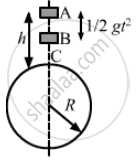
Let take the time taken to travel from point A to B as t .
Thus, the distance travelled by the ball is given by: = `1/2 "gt"^2` Where g is acceleration due to gravity.
Therefore, the distance BC is given by:
\[= h - \frac{1}{2}g t^2\] We are assuming this distance of the object from lens at any time t.
So here,
u = \[- \left( h - \frac{1}{2}g t^2 \right)\]
Taking:
Refractive index of air, μ1 = 1
Refractive index of sphere, μ2 = μ (given)
Thus, \[\frac{\mu}{v} - \frac{1}{- \left( h - \frac{1}{2}g t^2 \right)} = \frac{\mu - 1}{R}\]
\[ \Rightarrow \frac{\mu}{v} = \frac{\mu - 1}{R} - \frac{1}{\left( h - \frac{1}{2}g t^2 \right)} = \frac{\left( \mu - 1 \right)\left( h - \frac{1}{2}g t^2 \right) - R}{R\left( h - \frac{1}{2}g t^2 \right)}\]
Let v be the image distance at any time t. Then,
\[v = \frac{\mu R\left( h - \frac{1}{2}g t^2 \right)}{\left( \mu - 1 \right)\left( h - \frac{1}{2}g t^2 \right) - R}\]
Therefore, velocity of the image ( V ) is given by,
\[V = \frac{dv}{dt} = \frac{d}{dt}\left[ \frac{\mu R\left( h - \frac{1}{2}g t^2 \right)}{\left( \mu - 1 \right)\left( h - \frac{1}{2}g t^2 \right) - R} \right]\]
\[ = \frac{\mu R^2 gt}{\left[ \left( \mu - 1 \right)\left( h - \frac{1}{2}g t^2 \right) - R \right]^2}\]
APPEARS IN
RELATED QUESTIONS
A point source of light is placed at a distance of 2 f from a converging lens of focal length f. The intensity on the other side of the lens is maximum at a distance
A slide projector has to project a 35 mm slide (35 mm × 23 mm) on a 2 m × 2 m screen at a distance of 10 m from the lens. What should be the focal length of the lens in the projector?
An extended object is placed at a distance of 5.0 cm from a convex lens of focal length 8.0 cm. (a) Draw the ray diagram (to the scale) to locate the image and from this, measure the distance of the image from the lens. (b) Find the position of the image from the lens formula and see how close the drawing is to the correct result.
A 5 mm high pin is placed at a distance of 15 cm from a convex lens of focal length 10 cm. A second lens of focal length 5 cm is placed 40 cm from the first lens and 55 cm from the pin. Find (a) the position of the final image, (b) its nature and (c) its size.
A point object is placed at a distance of 15 cm from a convex lens. The image is formed on the other side at a distance of 30 cm from the lens. When a concave lens is placed in contact with the convex lens, the image shifts away further by 30 cm. Calculate the focal lengths of the two lenses.
Two convex lenses, each of focal length 10 cm, are placed at a separation of 15 cm with their principal axes coinciding. (a) Show that a light beam coming parallel to the principal axis diverges as it comes out of the lens system. (b) Find the location of the virtual image formed by the lens system of an object placed far away. (c) Find the focal length of the equivalent lens. (Note that the sign of the focal length is positive although the lens system actually diverges a parallel beam incident on it.)
According to new Cartesian sign conventions, all the distances are measured from the ______.
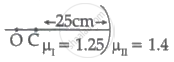
Region I and II are separated by a spherical surface of a radius of 25 cm. An object is kept in the region I at a distance of 40 cm from the surface. The distance of the image from the surface is ______.
A ray of light from a denser medium strikes a rarer medium at an angle of incidence i as shown in the figure. Refracted and reflected rays make an angle of 90° with each other. The angle of reflection and refraction are r and r'. The critical angle is ______.

Define the critical angle for a given pair of media and total internal reflection. Obtain the relation between the critical angle and refractive index of the medium.
A point object in the air is placed symmetrically at a distance of 60 cm in front of a concave spherical surface with a refractive index of 1.5. If the radius of curvature of the surface is 20 cm, find the position of the image formed.
Obtain an expression for refraction at a single convex spherical surface, i.e., the relation between μ1 (rarer medium), μ2 (denser medium), object distance u, image distance v and the radius of curvature R.
What is a spherical refracting surface?
Which of the following correctly states the relation for refraction at a spherical surface?
According to the Cartesian sign convention for refraction at a spherical surface, all distances are measured from:
For a real object placed to the left of a spherical refracting surface, the object distance u is:
Which set of variables is primarily involved in refraction at a spherical surface, as opposed to refraction at a plane surface?
An object is placed at a distance of 100 cm in air from a convex spherical surface of glass of refractive index 1.5. The radius of curvature is 20 cm. What is the image distance?
When a light ray strikes a curved surface and refracts, the amount of bending depends on:
