Advertisements
Advertisements
Question
What is toxicity ?
Advertisements
Solution
It refers to the kind of external osmotic environment of a cell or it refers to the type of solution outside the cell.
APPEARS IN
RELATED QUESTIONS
The process by which root hairs absorb water from the soil.
Study the diagram given below and answer the questions that follow:

- Name the process being studied in the above experiment.
- Explain the process mentioned in (a) above
- Why is oil placed over water?
- What do we observe with regard to the level of water when this set-up is placed in (1) bright sunlight, (2) humid conditions and (3) windy days?
- Mention any three adaptations found in plants to foster the process mentioned in (a) above
Choose the correct answer:
An example of a selective permeable membrane is __________
The diagram below represents a layer of epidermal cells showing a fully grown root hair. Study the diagram and answer the questions that follow:

Draw a diagram of the above root hair cell as it would appear when a concentrated solution of fertilizers is added near it.
The figure given below is a diagrammatic representation of a part of the cross-section of the root in the root hair zone. Study the same and then answer the questions that follow :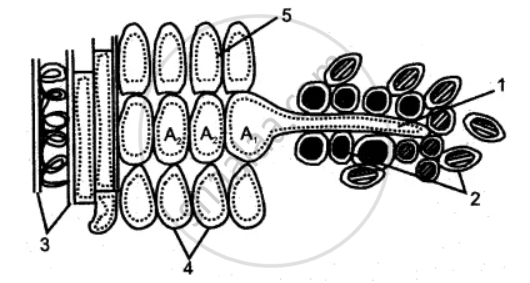
(i) Name the parts indicated by guidelines ‘1’ to ‘5’
(ii) Is the root hair cell unicellular or multi-cellular?
(iii) Draw a labeled diagram of the root hair cell as it would appear if some fertilizer is added to the soil close to it.
(iv) Name the process responsible for the entry of water molecules from the soil into A1 and then A2.
(v) What pressure is responsible for the movement of water in the direction indicated by arrows?
(vi) How is this pressure set up?
Name the following:
The kind of cells that constitute the cortex of a root.
Root hairs are ______
They are pipe-like, consisting of a group of specialised cells. They transport substances and form two-way traffic in plants. Which of the following terms qualify for the features mentioned above?
Root hair is a cytoplasmic extension of ______.
