English

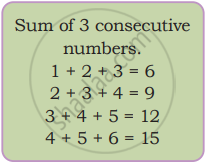
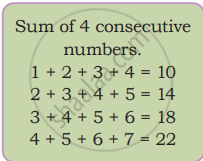
What is the difference between two successive sums in each box? Is it the same throughout?

Advertisements

Question
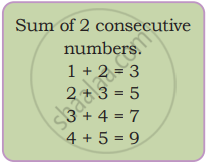
A math pattern box illustrating the sum of 2 consecutive numbers (e.g., 1 + 2 = 3, 2 + 3 = 5, 3 + 4 = 7, and 4 + 5 = 9) A math pattern display showing the sum of 3 consecutive numbers (e.g., 1 + 2 + 3 = 6, 2 + 3 + 4 = 9, 3 + 4 + 5 = 12, and 4 + 5 + 6 = 15). A math pattern layout demonstrating the sum of 4 consecutive numbers (e.g., 1 + 2 + 3 + 4 = 10, 2 + 3 + 4 + 5 = 14, 3 + 4 + 5 + 6 = 18, and 4 + 5 + 6 + 7 = 22$.

What is the difference between two successive sums in each box? Is it the same throughout?

Activity
Advertisements

Solution

In the 2-number box the difference is 2; in the 3-number box it is 3; in the 4-number box it is 4. Yes, the difference is the same throughout each box. Shifting the starting number by 1 increases every addend by 1, so the total increases by the number of addends: \[ (n+1)+(n+2)+\cdots+(n+k) - [n+(n+1)+\cdots+(n+k-1)] = k \]

shaalaa.com
  Is there an error in this question or solution?
Chapter 4: We the Travellers-2 - Intext Question [Page 45]

APPEARS IN

NCERT Maths Mela [English] Class 5
Chapter 4 We the Travellers-2
Intext Question | Q 2. | Page 45
Advertisements
Share
Notifications

Englishहिंदीमराठी


      Forgot password?
Use app×