In each of the boxes above, state whether the sums are even or odd. Explain why this is happening.
Advertisements
Question
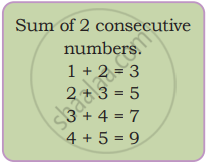
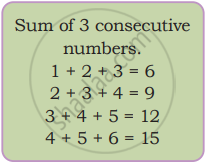
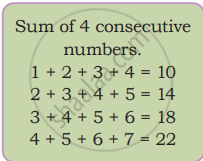
In each of the boxes above, state whether the sums are even or odd. Explain why this is happening.
Activity
Advertisements
Solution
- Box of 2 consecutive numbers: 3, 5, 7, 9 → all odd.
Reason: every pair of consecutive numbers has one even and one odd number, and even + odd = odd. - Box of 3 consecutive numbers: 6, 9, 12, 15 → even, odd, even, odd.
Reason: \[ \text{sum} = 3 \times \text{middle number} \], so the sum is even when the middle number is even and odd when the middle number is odd. - Box of 4 consecutive numbers: 10, 14, 18, 22 → all even.
Reason: in four consecutive numbers there are exactly two even and two odd numbers, and even + even + odd + odd = even.
shaalaa.com
Is there an error in this question or solution?
