Advertisements
Advertisements
Question
What is meant by zero error of vernier callipers ? How is it determined? Draw neat diagrams to explain it. How is it taken in account to get the correct measurement?
Advertisements
Solution
Due to mechanical errors, sometimes the zero mark of the vernier scale does not coincide with the zero mark of the main scale, the vernier callipers is said to have zero error.
It is determined by measuring the distance between the zero mark of the main scale and the zero mark of the vernier scale.
The zero error is of two kinds
(i) Positive zero error
(ii) Negative zero error
(i) Positive zero error: On bringing the two jaws together, if the zero mark of the vernier scale is on the right of the zero mark of the main scale, the error is said to be positive.

To find this error, we note the division of the vernier scale, which coincides with any division of the main scale. The number of this vernier division when multiplied by the least count of the vernier callipers, gives the zero error.
For example, for the scales shown, the least count is 0.01 cm and the 6th division of the vernier scale coincides with a main scale division.
Zero error = +6 × L.C. = +6 × 0.01 cm
= +0.06 cm
(ii) Negative zero error: On bringing the two jaws together, if the zero mark of the vernier scale is on the left of the zero mark of the main scale, then the error is said to be negative.

To find this error, we note the division of the vernier scale coinciding with any division of the main scale. The number of this vernier division is subtracted from the total number of divisions on the vernier scale and then the difference is multiplied by the least count.
For example, for the scales shown, the least count is 0.01 cm and the sixth division of the vernier scale coincides with a certain division of the main scale. The total number of divisions on vernier callipers is 10.
Zero error = - (10 - 6) × L.C.
= - 4 × 0.01 cm = - 0.04 cm
Correction:
To get correct measurement with vernier callipers having a zero error, the zero error with its proper sign is always subtracted from the observed reading.
Correct reading = Observed reading - zero error (with sign)
APPEARS IN
RELATED QUESTIONS
Define metre in terms of the wavelength of light.
In figure for vernier callipers, calculate the length recorded.
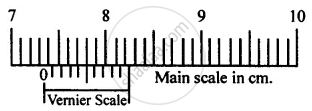
(a) A vernier scale has 10 divisions. It slides over the main scale, whose pitch is 1.0 mm. If the number of divisions on the left hand of zero of the vernier scale on the main scale is 56 and the 8th vernier scale division coincides with the main scale, calculate the length in centimetres.
(b) If the above instrument has a negative error of 0.07 cm, calculate the corrected length.
The least count of a vernier callipers is 0.01 cm and it has an error of + 0.07 cm. While measuring the radius of a sphere, the main scale reading is 2.90 cm and the 5th vernier scale division coincides with the main scale. Calculate the correct radius.
Define the term least count as applied to a vernier callipers.
State the correction if the negative error is 7 divisions when the least count is 0.01 cm.
How do you account for negative zero error, for calculating the correct diameter of wires?
What is the least count in the case of the following instrument?
Metre scale
