Advertisements
Advertisements
Questions
What is meant by inflationary gap?
Explain the concept of inflationary gap.
Explain briefly the concept of inflationary gap. Use diagram.
Explain the concept of inflationary gap with the help of a suitable diagram.
Explain the concept of inflationary gap with the help of a diagram. What is its impact on output?
Advertisements
Solution 1
Excess demand occurs in a situation when aggregate demand is more than aggregate supply corresponding to full employment. It leads to the reduction in inventories and inflation in the economy. This situation is considered an inflationary gap the difference between aggregate demand beyond full employment and aggregate demand at full employment.
Aggregate demand is the AD curve, and aggregate supply is the AS curve (as shown in the diagram below). While the aggregate demand curve and the aggregate supply curve intersect each other, the full employment equilibrium is attained at Point E. OY is the full employment level of output, and EY is the aggregate demand at full employment level of output. If the aggregate demand increases beyond the full employment level of output from EY to FY, then the economy will have excess demand, i.e., a situation of an inflationary gap (FY − EY = FE).

Solution 2
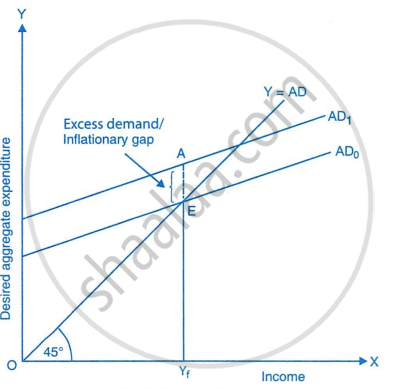
To put it another way, excess demand occurs when actual aggregate demand in an economy exceeds aggregate supply at full employment. When the economy is at full employment, excess demand cannot be eliminated because existing resources are already completely utilized. This additional demand will drive up the price level. A high level of aggregate spending relative to full employment output will result in shortages of items in the economy, driving up prices and causing inflation. Thus, extra demand has no effect on the quantity of output or employment in the economy but does cause inflation. This is why excess demand (or gap) is referred to as the “inflationary gap.” Inflationary gap refers to the amount by which actual aggregate demand exceeds aggregate supply at full employment. Thus, the inflationary gap represents the amount of surplus demand in the economy.
Notes
Students should refer to the answer according to their questions.
APPEARS IN
RELATED QUESTIONS
State the determinants of aggregate demand.
Explain the concept of ‘deficient demand’ in macroeconomics.
Explain how government spending can be helpful in removing deficient demand.
Aggregate demand can be increased by ______
Explain the concept of deflationary gap.
Name any two components of 'aggregate demand'.
Write explanatory answer:
What is Aggregate demand ? Explain the determinants of Aggregate demand.
Fill in the blank with appropriate alternatives given below
That part of income, which is not spent on consumption, is called __________.
State whether the following statement is true or false.
The equality between aggregate demand and aggregate supply determines the equilibrium level of employment.
Distinguish between:
Aggregate Demand and Aggregate Supply
State with reason whether you agree or disagree with the following statement.
Aggregate supply is influenced by the state of technology only.
Answer the following question.
State and discuss the components of Aggregate Demand in a two-sector economy.
What is meant by the “Effective Demand Principle” in the Keynesian theory of employment? Discuss using a schedule or a diagram.
A decrease in Cash Reserve Ratio will lead to ______
What is the circumstance when aggregate output is determined solely by the level of aggregate demand called?
If TR is 1,00,000₹ when ₹20,000 units are sold, then AR is equal to:
The slope of the supply curve is measured by ______.
With reference to Simple Keynesian model, give the meaning of ex-ante demand.
