Advertisements
Advertisements
Questions
Explain the concept of ‘deficient demand’ in macroeconomics.
What is ‘deficient demand’?
Advertisements
Solution
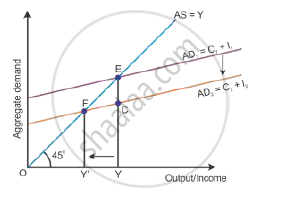
Deficient demand means a situation when the aggregate demand is short of the aggregate supply corresponding to full employment in the economy. It leads to a fall in the general price level and results in deflation, i.e., AD < AS. Aggregate demand is shown by the AD curve and aggregate supply is shown by the AS curve (as shown in the diagram below). While the aggregate demand curve and the aggregate supply curve intersect each other, the full employment equilibrium is attained at Point E. OY is the full employment level of output, and EY is the aggregate demand at the full employment level of output. If the aggregate demand decreases below the full employment level of output from EY to CY, then the economy will have deficient demand (EY − CY = EC).
APPEARS IN
RELATED QUESTIONS
Explain national income equilibrium through aggregate demand and aggregate supply. Use diagram. Also explain the changes that take place in an economy when the economy is not in equilibrium
Why does consumption curve not start from the origin?
State three measures to reduce inflationary gap.
Name any two components of 'aggregate demand'.
Explain the role of Cash Reserve Ratio in removing an inflationary gap
Discuss the situation when aggregate demand is more than aggregate supply at full employment income level.
Write explanatory answer:
What is Aggregate demand ? Explain the determinants of Aggregate demand.
State whether the following statements are True or False with reason:
Income earned from foreign investment is considered for aggregate demand.
Write Short note on:
Average Propensity to Consume
Write Short note on:
Marginal Propensity to Consume
Answer the following question:
What are the determinants of Aggregate Demand (AD)?
Choose the correct from given options
When aggregate demand is greater than aggregate supply, inventories
What is meant by Equilibrium income?
Identify the correctly matched pair from Column A to Column B:
| Column A | Column B |
| (1) Y = AD | (a) Level of output at full employment |
| (2) Forward Multiplier | (b) Withdrawal of investment decreases income |
| (3) Paradox of Thrift | (c) People save less or same as before |
| (4) Multiplier (k) < 1 | (d) 0 < MPC < 1 |
Which of the following statement is true?
The equilibrium level of income/output is established when ______
Aggregate demand can be increased by:
“In an economy ex-ante Aggregate Demand is less than ex-ante Aggregate Supply.”
Explain its impact on the level of output, income and employment.
“In an economy Planned spending is more than Planned output”.
Explain its impact on the level of output, income and employment.
With the help of a diagram, determine the equilibrium level of output and income by using Aggregate demand and aggregate supply approach.
