Advertisements
Advertisements
Question
What is marginal propensity to consume?
Advertisements
Solution
Marginal propensity to consume refers to the ratio of change in the consumer’s expenditure due to the change in disposable income (income after deducting taxes). In other words, MPC measures how consumption will vary with the change in income.
So,
`MPC=(DeltaC)/(DeltaY)`
Where,
ΔC = Change in consumption
ΔY = Change in income
For example, if income increases from Rs 200 crores to Rs 250 crores and consumption increases from Rs 20 crores to Rs 40 crores, it implies that 0.4 is the MPC or 40% increase in the income is being consumed.
This can further be explained with the help of a table and a diagram.
If income and consumption are:-
| Income in Rs (Y) |
Consumption Expenditure in Rs (C) |
| 200 | 20 |
| 250 | 40 |
Then `MPC=(DeltaC)/(DeltaY)=20/50=0.4`
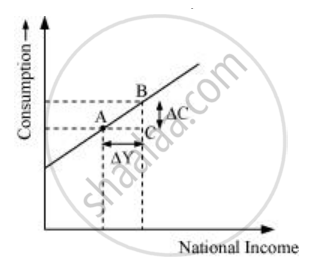
Also, MPC can be explained with the given diagram.
In the diagram, x-axis represents national income and y-axis represents consumption level.
So, `MPC=(BC)/(AC)`
The relationship between MPC and MPS can be explained as
Y = C + S (Assuming that the income earned is either consumed or saved)
Or, ΔY = ΔC + ΔS
Dividing both sides by ΔY
`(DeltaY)/(DeltaY)=(DeltaC)/(DeltaY)+(DeltaS)/(DeltaY) ...[(DeltaS)/(DeltaY)=MPS]`
Or, 1 = MPC + MPS
Or, MPC = 1 − MPS
Or, MPS = 1 − MPC
So, the sum of MPC and MPS is always equal to unity.
APPEARS IN
RELATED QUESTIONS
Given the following data, find the missing value of 'Government Final Consumption Expenditure' and 'Mixed Income of Self Employed'.
| S.No. | Particulars | Amount (In ₹ crores) |
| (i) | National Income | 71,000 |
| (ii) | Gross Domestic Capital Formation | 10,000 |
| (iii) | Government Final Consumption Expenditure | ? |
| (iv) | Mixed Income of Self Employed | ? |
| (v) | Net Factor Income from Abroad | 1,000 |
| (vi) | Net Indirect Taxes | 2,000 |
| (vii) | Profits | 1,200 |
| (viii) | Wages & Salaries | 15,000 |
| (ix) | Net Exports | 5,000 |
| (x) | Private Final Consumption Expenditure | 40,000 |
| (xi) | Consumption of Fixed Capital | 3,000 |
| (xii) | Operating Surplus | 30,000 |
Final goods refer to those goods which are used either for ______ or for ______.
On the basis of following schedule, answer the given questions:
| Income (in ₹ crores) |
Savings (in ₹ crores) |
| 0 | -20 |
| 50 | -10 |
| 100 | 0 |
| 150 | 30 |
| 200 | 60 |
- Calculate Marginal Propensity to Save (MPS) at ₹ 150 crores level of income.
- What is the value of Autonomous Consumption?
Which formula represents the consumption function?
At zero income, what happens to consumption?
How does the consumption curve begin and move as income changes?
What is autonomous consumption?
What is induced consumption?
Which expression represents induced consumption in the consumption function?
Which formula correctly defines Marginal Propensity to Consume (MPC)?
Within which range does the value of MPC always lie?
Which formula correctly defines Marginal Propensity to Save (MPS)?
If \[MPC=0.8\], what is MPS?
Which equation is equivalent to \[MPC+MPS=1\]?
What does \[APC=\frac{C}{Y}\] measure?
