Advertisements
Advertisements
प्रश्न
What is marginal propensity to consume?
Advertisements
उत्तर
Marginal propensity to consume refers to the ratio of change in the consumer’s expenditure due to the change in disposable income (income after deducting taxes). In other words, MPC measures how consumption will vary with the change in income.
So,
`MPC=(DeltaC)/(DeltaY)`
Where,
ΔC = Change in consumption
ΔY = Change in income
For example, if income increases from Rs 200 crores to Rs 250 crores and consumption increases from Rs 20 crores to Rs 40 crores, it implies that 0.4 is the MPC or 40% increase in the income is being consumed.
This can further be explained with the help of a table and a diagram.
If income and consumption are:-
| Income in Rs (Y) |
Consumption Expenditure in Rs (C) |
| 200 | 20 |
| 250 | 40 |
Then `MPC=(DeltaC)/(DeltaY)=20/50=0.4`
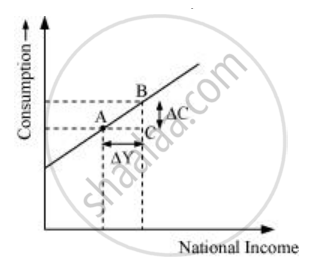
Also, MPC can be explained with the given diagram.
In the diagram, x-axis represents national income and y-axis represents consumption level.
So, `MPC=(BC)/(AC)`
The relationship between MPC and MPS can be explained as
Y = C + S (Assuming that the income earned is either consumed or saved)
Or, ΔY = ΔC + ΔS
Dividing both sides by ΔY
`(DeltaY)/(DeltaY)=(DeltaC)/(DeltaY)+(DeltaS)/(DeltaY) ...[(DeltaS)/(DeltaY)=MPS]`
Or, 1 = MPC + MPS
Or, MPC = 1 − MPS
Or, MPS = 1 − MPC
So, the sum of MPC and MPS is always equal to unity.
APPEARS IN
संबंधित प्रश्न
Aggregate Demand is not determined by which of the following.
On the basis of following schedule, answer the given questions:
| Income (in ₹ crores) |
Savings (in ₹ crores) |
| 0 | -20 |
| 50 | -10 |
| 100 | 0 |
| 150 | 30 |
| 200 | 60 |
- Calculate Marginal Propensity to Save (MPS) at ₹ 150 crores level of income.
- What is the value of Autonomous Consumption?
"In an economy, the autonomous consumption is ₹ 100 and Marginal Propensity to Consume (MPC) is 0.6. If the equilibrium level of Income is 2,000, then the autonomous investment is ₹ 300." Justify the statement with valid calculation.
At the break-even point level of incomes for the economy is ₹ 10,000 crores and if the people tends to save 20 per cent of their additional income, then calcualte the value of autonomous consumption.
Read the following statements carefully:
Statement 1: The induced consumption shows, the direct relation between consumption and income.
Statement 2: With a certain increase in income, induced consumption also increases.
In the light of the given statements, choose the correct alternative from the following:
Statement 1: Consumption function assumes that, consumption changes at a constant rate as income changes.
Statement 2: Autonomous consumption is the ratio of total consumption (C) to total income (Y).
In light of the given statements, choose the correct alternative from the following:
Which formula represents the consumption function?
How does the consumption curve begin and move as income changes?
What is autonomous consumption?
Which component of \[C=\bar{C}+cY\] is independent of income?
What is induced consumption?
Which expression represents induced consumption in the consumption function?
Which formula correctly defines Marginal Propensity to Save (MPS)?
Which equation is equivalent to \[MPC+MPS=1\]?
What does \[APS=\frac{S}{Y}\] measure?
What is saving at a point where income equals consumption on the 45° line?
What does it mean when the consumption curve is below the 45° line?
What does it mean when the consumption curve is above the 45° line?
