Advertisements
Advertisements
Question
What happens when oxidation of acetone oxime with trifluoroperoxy acetic acid
Advertisements
Solution
Oxidation of acetone oxime with trifluoroperoxy acetic acid gives 2-nitropropane.
\[\begin{array}{cc}
\ce{CH3 - C = N - OH ->[CF3COOH][(O)] CH3 - CH - NO2}\\
\phantom{}|\phantom{.............................}|\phantom{..}\\
\phantom{.}\ce{\underset{(Acetone oxime)}{CH3}}\phantom{..................}\ce{\underset{(2-nitropropane)}{CH3}}\phantom{}
\end{array}\]
APPEARS IN
RELATED QUESTIONS
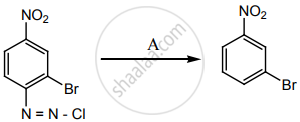
‘A’ is:
C5H13N reacts with HNO2 to give an optically active compound – The compound is ____________.
What happens when 2-Nitropropane boiled with HCl?
What happens when oxidation of tert-butylamine with KMnO4?
How will you convert nitrobenzene into hydrozobenzene?
How will you convert nitrobenzene into N-phenylhydroxylamine?
Identify A to E in the following sequence of reactions.

Account for the following.
Aniline does not undergo Friedel – Crafts reaction.
Account for the following:
Aniline does not undergo Friedel - Crafts reaction.
Account for the following.
Aniline does not undergo Friedel–Crafts reaction
