Advertisements
Advertisements
Question
What is the force on a current-carrying wire that is parallel to a magnetic field? Give reason for your answer.
Advertisements
Solution
The force on a current-carrying wire parallel to the magnetic field is zero because the magnetic force on the wire is due to the force experienced by moving electrons in the conductor. Further, the magnetic force has rotatory effect on electron motion only. Therefore, in parallel condition, this rotating effect is zero and this results in zero force on the conductor.
APPEARS IN
RELATED QUESTIONS
Which of the following property of a proton can change while it moves freely in a magnetic field? (There may be more than one correct answer.)
Imagine that you are sitting in a chamber with your back to one wall. An electron beam, moving horizontally from back wall towards the front wall, is deflected by a strong magnetic field to your right side. What is the direction of magnetic field?
State qualitatively the effect of inserting an iron core into a current-carrying solenoid.
Name the rule for finding the direction of magnetic field produced by a straight current-carrying conductor.
What is the shape of a current-carrying conductor whose magnetic field pattern resembles that of a bar magnet?
Name and state the rule to determine the direction of magnetic field around a straight current-carrying conductor.
What is the shape of field lines inside a current-carrying solenoid? What does the pattern of field lines inside a current-carrying solenoid indicate?
For Fleming's left-hand rule, write down the three things that are 90° to each other, and next to each one write down the finger or thumb that represents it.
If the current in a wire is flowing in the vertically downward direction and a magnetic field is applied from west to east, what is the direction of force in the wire?
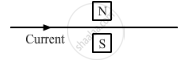
Which way does the wire in the diagram below tend to move?
Two coils A and B of insulated wire are kept close to each other. Coil A is connected to a galvanometer while coil B is connected to a battery through a key. What would happen if:
the current is stopped by removing the plug from the key?
Explain your answer mentioning the name of the phenomenon involved.
State condition when magnitude of force on a current carrying conductor placed in a magnetic field is maximum?
i) Which principle is explained in this figure?
ii) Which rule is used to find out the direction of a force in this principle?
iii) In which machine this principle is used? Draw a diagram showing working of that machine
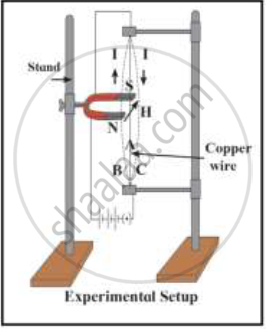
Name and state the rule of determine the direction of force experienced by a current carrying straight conductor placed in a uniform magnetic field which is perpendicular to it.
The following diagram shows two parallel straight conductors carrying the same current. Copy the diagram and draw the pattern of the magnetic field lines around them showing their directions. What is the magnitude of the magnetic field at a point 'X' which is equidistant from the conductors? Give justification for your answer.

State under what conditions force acting on a current carrying conductor which is freely suspended in a magnetic field can be Zero.
Write Fleming’s left hand rule.
|
The graph (fig A) illustrates the correlation between the number of protons (x-axis) and the number of neutrons (y-axis) for elements A, B, C, D, and E in the periodic table. These elements are denoted by the letters rather than their conventional symbols. When the element C, depicted in the graph, undergoes radioactive decay, it releases radioactive rays. When these rays are directed into the plane of the paper in the presence of a magnetic field, as indicated in the fig B, they experience deflection, causing them to move upwards.
|
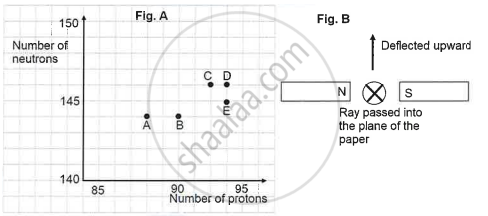
Name the law used to identify the radioactive radiation emitted by the element.
