Advertisements
Advertisements
Question
What do you understand by G.S.T?
Advertisements
Solution
"Goods and services tax" refers to any tax on the supply of goods, services, or both, excluding taxes on the supply of alcoholic beverages for human consumption. It is an indirect tax that combines various taxes, such as sales tax, excise tax, VAT, and so on, into a single tax for the entire country. GST is levied at every stage of the supply chain of goods or services, from production to the final retail level, replacing the various archaic tax structures.
APPEARS IN
RELATED QUESTIONS
Give the relationship between the revenue deficit and the fiscal deficit.
Suppose that for a particular economy, investment is equal to 200, government purchases are 150, net taxes (that is lump-sum taxes minus transfers) is 100 and consumption is given by C = 100 + 0.75Y (a) What is the level of equilibrium income? (b) Calculate the value of the government expenditure multiplier and the tax multiplier. (c) If government expenditure increases by 200, find the change in equilibrium income.
Consider an economy described by the following functions:- C = 20 + 0.80Y, I = 30, G = 50, TR = 100 (a) Find the equilibrium level of income and the autonomous expenditure multiplier in the model. (b) If government expenditure increases by 30, what is the impact on equilibrium income? (c) If a lump-sum tax of 30 is added to pay for the increase in government purchases, how will equilibrium income change?
Suppose marginal propensity to consume is 0.75 and there is a 20 per cent proportional income tax. Find the change in equilibrium income for the following (a) Government purchases increase by 20 (b) Transfers decrease by 20.
Explain the relation between government deficit and government debt.
Answer the following question.
In the given figure, what does the gap 'KT' represent? State any two fiscal measures to correct the situation.
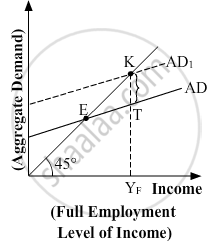
Suppose you are a member of the "Advisory Committee to the Finance Minister of India". The Finance Minister is concerned about the rising Revenue Deficit in the budget.
Suggest anyone measure to control the rising Revenue Deficit of the government.
Fiscal deficit = ______.
Which of the following statement is true?
Which of the following factors necessitated the need for economic reforms?
How do we get the primary deficit from the fiscal deficit?
The shape of average revenue curve in monopoly is ______
How good is the system of G.S.T as compared to the old tax system?
On the basis of the given information, calculate the value of:
- Fiscal deficit
- Primary deficit
| S.No. | Items | 2021-22 (₹ in crore) |
| (i) | Revenue Receipts | 20 |
| (ii) | Capital Expenditure | 15 |
| (iii) | Revenue Deficit | 10 |
| (iv) | Non-debt creating capital receipts | 50% of revenue receipts |
| (v) | Interest Payments | 4 |
A large amount of fiscal deficit proves to be counter productive. Give any two reasons in support of this statement.
Which of the following formulas correctly defines the Revenue Deficit?
The Primary Deficit is always smaller than the Fiscal Deficit because:
