Advertisements
Advertisements
Question
What is dialysis? Under what condition is it carried out?
Advertisements
Solution 1
Dialysis involves the use of artificial kidney or a dialysis machine. The patient's blood is from the radial artery is led through the machine where excess salts and urea is removed. The purified blood is then returned to a vein in the same arm.
Dialysis is carried out in case of failure of both the kidneys. In case there is a permanent damage, then the dialysis is to be repeated for about 12 hours twice a week.
Solution 2
An artificial kidney is a dialysis machine. When both the kidneys become fail to work the dialysis machine is used out. The patient’s blood is led from the radial artery in his arm through the machine where the urea and excess salts are removed and the purified blood is returned to a vein in the same arm. In case of permanent damage to the kidneys, dialysis has to be repeated for about 12 hours twice a week.
RELATED QUESTIONS
Give biological reasons for the following statements: There is frequent urination in winter than in summer
Draw a neat labelled diagram of the human excretory system.
Fill in the blank.
Malpighian body consists of Bowman’s capsule and .....................
Answer the following in short.
List five waste products of plants.
If you donate one kidney to a needy patient, would it cause any harm to you? Give reason.
Study the diagram given alongside and then answer the question that follow:
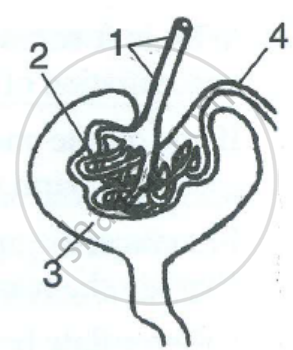
What is the technical term given to the process occurring in 2 and 3? Briefly describe the process.
Differentiate between:
Ureter and Urethra.
Given below is a simple diagram of the human kidney cut open longitudinally. Answer the following questions: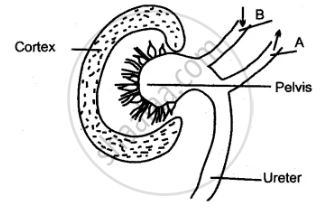
c
(v) Write two differences in the composition of the blood flowing through blood vessels A and B.
Choose the Odd One Out:
The product of the process of deamination is ______.
