Advertisements
Advertisements
प्रश्न
What is dialysis? Under what condition is it carried out?
Advertisements
उत्तर १
Dialysis involves the use of artificial kidney or a dialysis machine. The patient's blood is from the radial artery is led through the machine where excess salts and urea is removed. The purified blood is then returned to a vein in the same arm.
Dialysis is carried out in case of failure of both the kidneys. In case there is a permanent damage, then the dialysis is to be repeated for about 12 hours twice a week.
उत्तर २
An artificial kidney is a dialysis machine. When both the kidneys become fail to work the dialysis machine is used out. The patient’s blood is led from the radial artery in his arm through the machine where the urea and excess salts are removed and the purified blood is returned to a vein in the same arm. In case of permanent damage to the kidneys, dialysis has to be repeated for about 12 hours twice a week.
संबंधित प्रश्न
The kidneys in human beings are a part of the system for ______.
Name the Following
The organ which produces urea.
The form in which glucose in stored in liver.
What are the methods used by plants to get rid of their waste products?
The following diagram represents a mammalian kidney tubule (nephron) and its blood supply.
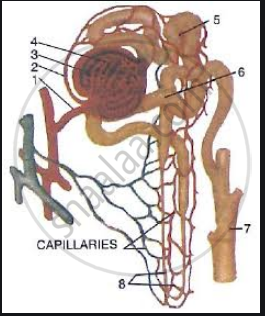
Parts indicated by the guidelines 1to 8 are as follows:
1. Afferent arteriole from renal artery
2. Efferent arteriole
3. Bowman's capsule
4. Glomerulus
5. Proximal convoluted tubule with blood capillaries
6. Distal convoluted tubule with blood capillaries
7. Collecting tubule
8. U-shaped loop of Henle
Study the diagram and answer the question that follow:
Where is most water reabsorbed ?
Explain the Term: Glomerulus
Complete the following sentence with appropriate word:
The sum total of all the chemical reactions taking place in the cell is known as ______.
Write the functional activity of the following structure: Kidney
Hypotonic filtrate is formed in _______.
The process of removal of unwanted metabolic wastes from the body is called ______.
