Advertisements
Advertisements
Question
Verify the division algorithm i.e. Dividend = Divisor × Quotient + Remainder, in each of the following. Also, write the quotient and remainder.
| Dividend | Divisor |
| 4y3 + 8y + 8y2 + 7 | 2y2 − y + 1 |
Advertisements
Solution
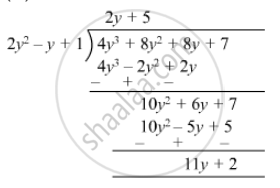
Quotient = 2y + 5
Remainder = 11y + 2
Divisor = 2y2 - y + 1
Divisor x Quotient + Remainder = (2y2 - y + 1) (2y + 5) + 11y + 2
= 4y3 +10y2 - 2y2 - 5y + 2y + 5 + 11y + 2
= 4y3 + 8y2 + 8y + 7
= Dividend
Thus,
Divisor x Quotient + Remainder = Dividend
Hence verified.
RELATED QUESTIONS
Divide the given polynomial by the given monomial.
(5x2 − 6x) ÷ 3x
Divide the given polynomial by the given monomial.
8(x3y2z2 + x2y3z2 + x2y2z3) ÷ 4x2y2z2
Write the degree of each of the following polynomials.
5x2 − 3x + 2
Write the degree of each of the following polynomials.
2x + x2 − 8
Write each of the following polynomials in the standard form. Also, write their degree.
x2 + 3 + 6x + 5x4
Write each of the following polynomials in the standard form. Also, write their degree.
a2 + 4 + 5a6
Write each of the following polynomials in the standard form. Also, write their degree.
(y3 − 2)(y3 + 11)
Divide 2y5 + 10y4 + 6y3 + y2 + 5y + 3 by 2y3 + 1.
Verify the division algorithm i.e. Dividend = Divisor × Quotient + Remainder, in each of the following. Also, write the quotient and remainder.
| Dividend | Divisor |
| 6y5 + 4y4 + 4y3 + 7y2 + 27y + 6 | 2y3 + 1 |
Using division of polynomials, state whether
x + 6 is a factor of x2 − x − 42
