Advertisements
Advertisements
Question
Using sodium hydroxide solution, how will you distinguish:
Lead hydroxide from magnesium hydroxide.
Advertisements
Solution
Lead hydroxide from magnesium hydroxide.
When sodium hydroxide is added, lead hydroxide is dissolved in it but when sodium hydroxide is added to magnesium hydroxide, there is no visible reaction i.e. it remains insoluble.
APPEARS IN
RELATED QUESTIONS
State one relevant observation for given reactions:
Action of Sodium hydroxide solution on ferrous sulfate solution.
Identify the cations in the following case:
NaOH solution, when added to the Solution (A), gives a reddish brown precipitate
What do you observe when ammonium salt is heated with caustic soda solution?
Using sodium hydroxide solution, how will you distinguish:
Iron (II) chloride from iron (III) chloride
Sodium hydroxide solution is added to solution A. A white precipitate is formed which is soluble in excess sodium hydroxide. Name the metal ion present in A.
Sodium hydroxide solution is added first in a small quantity, then in excess to the aqueous salt solutions of copper (II) sulphate, zinc nitrate, lead nitrate, calcium chloride, and iron (III) sulphate. Copy the following table and write the colour of the precipitate in (i) to (v) and the nature of the precipitate (soluble or insoluble) in (vi) to (x).
| Aqueous salt solution | Colour of precipitate when NaOH is added in a small quantity | Nature of precipitate (soluble or insoluble) when NaOH is added in excess |
| Copper (II) sulphate | (i) | (vi) |
| Zinc nitrate | (ii) | (vii) |
| Lead nitrate | (iii) | (viii) |
| Calcium chloride | (iv) | (ix) |
| Iron (III) Sulphate | (v) | (x) |
Distinguish by adding:
Sodium hydroxide solution and ammonium hydroxide solution to lead nitrate solution and zinc nitrate solution.
Distinguish by adding:
Sodium hydroxide solution and ammonium hydroxide solution to copper salt solution and ferrous salt solution.
A student was asked to perform an experiment in the laboratory based on the instructions given:
Observe the picture given below and state one observation for the experiment you would notice on mixing the given solution.
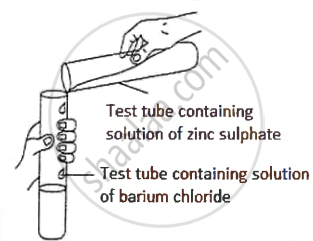
Write the word equation when ammonium salt is heated with caustic soda solution.
