Advertisements
Advertisements
Question
Aqueous lead (II) nitrate can be distinguished from aqueous zinc nitrate by adding any of the following solutions in excess, except:
Options
aqueous potassium chloride aqueous sodium sulphate dilute sulphuric acid sodium hydroxide solution
aqueous sodium sulphate
dilute sulphuric acid
sodium hydroxide solution
Advertisements
Solution
Sodium hydroxide solution
RELATED QUESTIONS
What do you observe when caustic soda solution is added to the following solution, first a little and then in excess:
Pb(NO3)2
Write balanced equation for this reaction.
Name a yellow monoxide that dissolves in hot and concentrated caustic alkali.
Using sodium hydroxide solution, how will you distinguish:
Lead hydroxide from magnesium hydroxide.
Write equation for the reaction that will take place when copper sulphate solution is added to sodium hydroxide solution.
Write the observation, and balanced equation for the following reaction:
Sodium hydroxide is added dropwise to a solution of zinc sulphate, till it is in excess.
Using Sodium hydroxide solution, how would you distinguish: Ammonium sulphate from sodium sulphate.
Using Sodium hydroxide solution, how would you distinguish: Zinc nitrate solution from calcium nitrate solution.
Using Sodium hydroxide solution, how would you distinguish: Iron(II) chloride from Iron (III) chloride
What is observed when hot, concentrated caustic soda solution is added to zinc? Write a balanced equation.
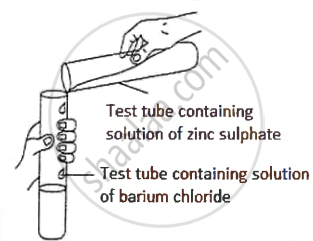
A student was asked to perform an experiment in the laboratory based on the instructions given:
Observe the picture given below and state one observation for the experiment you would notice on mixing the given solution.