Advertisements
Advertisements
Question
Using Sodium hydroxide solution, how would you distinguish: Iron(II) chloride from Iron (III) chloride
Advertisements
Solution
Iron (III) chloride on reacting with sodium hydroxide forms brown ppt.
\[\ce{FeCl3(aq) + 3NaOH(aq) -> \underset{\text{brown}}{ Fe(OH)3(s)} + 3NaCl(aq)}\]
Iron (II) chloride on reacting with sodium hydroxide forms green ppt.
\[\ce{FeCl2(aq) + 2NaOH(aq) -> \underset{\text{green}}{Fe(OH)2(s)} + 2NaCl(aq)}\]
APPEARS IN
RELATED QUESTIONS
Identify the cations in the following case:
NaOH solution, when added to the Solution (A), gives a reddish brown precipitate
Name the kind of particles present in sodium hydroxide solution.
Name a white, insoluble oxide that dissolves when fused with caustic soda or caustic potash.
Using sodium hydroxide solution, how will you distinguish:
Iron (II) chloride from iron (III) chloride
A white solid A when heated with sodium hydroxide solution, gives a pungent gas B, which turns red litmus blue. The solid, when dissolved in dilute nitric acid and treated with silver nitrate gives a white precipitate of C which is soluble in an ammonia solution.
Write balanced equation reaction of sodium hydroxide solution with iron (III) chloride solution.
Distinguish by adding:
Sodium hydroxide solution and ammonium hydroxide solution to calcium salt solution and lead salt solution.
A student was asked to perform an experiment in the laboratory based on the instructions given:
Observe the picture given below and state one observation for the experiment you would notice on mixing the given solution.
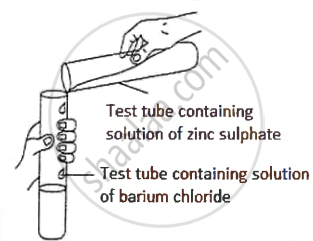
A student was asked to perform an experiment in the laboratory based on the instructions given:
Observe the picture given below and state one observation for the experiment you would notice on mixing the given solution.
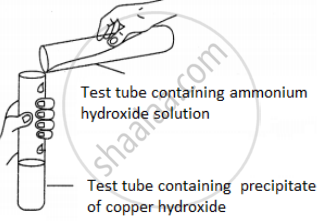
Name the metal hydroxides which are insoluble in caustic soda solution.
