Advertisements
Advertisements
Question
Using Bohr's postulates, derive the expression for the total energy of the electron in the stationary states of the hydrogen atom ?
Advertisements
Solution
According to Bohr’s 2nd postulate, we have : `L_n= mv_nr_n =(nh)/(2π)`
where,
n = principle quantum
vn = speed of the moving electron in the nth orbit
rn = radius of the nthorbit
The electrostatic force of attraction between the electron and the nucleus provides the necessary centripetal force to the electron.
\[\frac{m v^2}{r} = \frac{1}{4 \pi\epsilon_0}\frac{e^2}{r^2}\]
`V_n = e/(sqrt4π∈_0 mr_n)`
`∴ V_n = 1/n e^2/(4π∈_0)1/((h/(2π))`
`r_n =(n^2/m)(h/(2π))^2(4π∈_0)/e^2 `
Total energy, En = K.E. + P.E. =
RELATED QUESTIONS
(i) State Bohr's quantization condition for defining stationary orbits. How does the de Broglie hypothesis explain the stationary orbits?
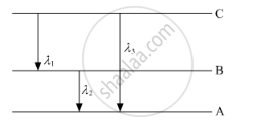
(ii) Find the relation between three wavelengths λ1, λ2 and λ3 from the energy-level diagram shown below.
Find the frequency of revolution of an electron in Bohr’s 2nd orbit; if the radius and speed of electron in that orbit is 2.14 × 10⁻¹⁰ m and 1.09 × 10⁶ m/s respectively. [π= 3.142]
What is the maximum number of emission lines when the excited electron of an H atom in n = 6 drops to the ground state?
Radiation from hydrogen discharge tube falls on a cesium plate. Find the maximum possible kinetic energy of the photoelectrons. Work function of cesium is 1.9 eV.
Calculate the de-Broglie wavelength associated with the electron revolving in the first excited state of the hydrogen atom. The ground state energy of the hydrogen atom is −13.6 eV.
The spectral line obtained when an electron jumps from n = 5 to n = 2 level in hydrogen atom belongs to the ____________ series.
The first ionization energy of H is 21.79 × 10⁻¹⁹ J. The second ionization energy of He atom is ______ × 10-19J.
A 100 eV electron collides with a stationary helium ion (He+) in its ground state and exits to a higher level. After the collision, He+ ions emit two photons in succession with wavelengths 1085 Å and 304 Å. The energy of the electron after the collision will be ______ eV.
Given h = 6.63 × 10⁻³⁴ Js.
Using Bohr’s Theory of hydrogen atom, obtain an expression for the velocity of an electron in the nth orbit of an atom.
What would happen to a revolving electron that continuously lost energy?
