Advertisements
Advertisements
Question
Unequal masses will not balance on a fulcrum if they are at equal distance from it; one side will go up and the other side will go down.
Unequal masses will balance when the following proportion is true:
`("mass"1)/("length"2) = ("mass"2)/("length"1)`

Two children can be balanced on a seesaw when
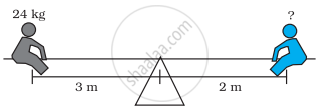
`("mass"1)/("length"2) = ("mass"2)/("length"1)`. The child on the left and child on the right are balanced. What is the mass of the child on the right?
Advertisements
Solution
It is given that, for balancing.
`("Mass" 1)/("Length" 2) = ("Mass" 2)/("Length" 1)`
According to the question,
Mass 1 = 24 kg, length 1 = 3 m and length 2 = 2 m
∴ `24/2 = ("Mass" 2)/3` ...[By cross-multiplication]
⇒ Mass 2 = `(24 xx 3)/2` = 36 kg
APPEARS IN
RELATED QUESTIONS
If x, y, z are in continued proportion prove that `(x + y)^2/(y + z)^2 = x/z`
Find the two numbers such that their mean proprtional is 24 and the third proportinal is 1,536.
Using the properties of proportion, solve for x, given. `(x^4 + 1)/(2x^2) = (17)/(8)`.
Find the value of x if 5 : 3 : : x : 6.
If x, y, z are in continued proportion, prove that: `(x + y)^2/(y + z)^2 = x/z`.
Sleeping time of a python in a 24 hour clock is represented by the shaded portion in the following figure.
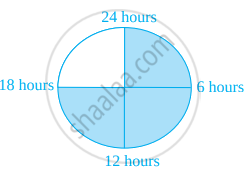
The ratio of sleeping time to awaking time is ______.
Write True (T) or False (F) against the following statement:
0.9 : 0.36 : : 10 : 4
If x : y = y : z, then x2 : y2 is ______.
The table, given below, shows the values of x and y, where x is proportional (directly proportional) to y.
| x | A | 24 | 15 |
| y | 12 | B | 20 |
The values of A and B are:
Which of the following statements correctly defines a proportion involving four non-zero quantities a, b, c, and d?
