Advertisements
Advertisements
प्रश्न
Unequal masses will not balance on a fulcrum if they are at equal distance from it; one side will go up and the other side will go down.
Unequal masses will balance when the following proportion is true:
`("mass"1)/("length"2) = ("mass"2)/("length"1)`

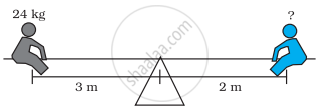
Two children can be balanced on a seesaw when
`("mass"1)/("length"2) = ("mass"2)/("length"1)`. The child on the left and child on the right are balanced. What is the mass of the child on the right?
Advertisements
उत्तर
It is given that, for balancing.
`("Mass" 1)/("Length" 2) = ("Mass" 2)/("Length" 1)`
According to the question,
Mass 1 = 24 kg, length 1 = 3 m and length 2 = 2 m
∴ `24/2 = ("Mass" 2)/3` ...[By cross-multiplication]
⇒ Mass 2 = `(24 xx 3)/2` = 36 kg
APPEARS IN
संबंधित प्रश्न
Using the properties of proportion, solve for x, given `(x^4 + 1)/(2x^2) = 17/8`.
Given, `x/(b - c ) = y/(c - a ) = z/(a - b)` , Prove that
ax+ by + cz = 0
Given four quantities p, q, r and s are in proportion, show that
q2(p - r) : rs (q - s) =(p2- q2- pq): ( r2-s2-rs).
Find two nurnbers whose mean proportional is 12 and the third proportional is 324.
If b is the mean proportional between a and c, prove that `(a^2 - b^2 + c^2)/(a^-2 -b^-2 + c^-2)` = b4.
Find the fourth proportional to 9.6 kg, 7.2 kg, 28.8 kg
The ratio 92 : 115 in its simplest for is
If a, b, c are in proportion, then
If 24 workers can build a wall in 15 days, how many days will 8 workers take to build a similar wall?
Write True (T) or False (F) against the following statement:
21 : 6 : : 35 : 10
