Advertisements
Advertisements
प्रश्न
Unequal masses will not balance on a fulcrum if they are at equal distance from it; one side will go up and the other side will go down.
Unequal masses will balance when the following proportion is true:
`("mass"1)/("length"2) = ("mass"2)/("length"1)`

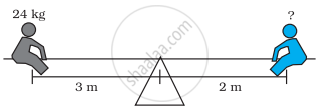
Two children can be balanced on a seesaw when
`("mass"1)/("length"2) = ("mass"2)/("length"1)`. The child on the left and child on the right are balanced. What is the mass of the child on the right?
Advertisements
उत्तर
It is given that, for balancing.
`("Mass" 1)/("Length" 2) = ("Mass" 2)/("Length" 1)`
According to the question,
Mass 1 = 24 kg, length 1 = 3 m and length 2 = 2 m
∴ `24/2 = ("Mass" 2)/3` ...[By cross-multiplication]
⇒ Mass 2 = `(24 xx 3)/2` = 36 kg
APPEARS IN
संबंधित प्रश्न
Find the mean proportion of the following :
ab3 and a3b
Given four quantities p, q, r and s are in proportion, show that
q2(p - r) : rs (q - s) =(p2- q2- pq): ( r2-s2-rs).
Find the fourth proportional to:
2xy, x2, y2
If a, b, c are in continued proportion, prove that a : c = (a2 + b2) : (b2 + c2).
If a, b, c, d are in continued proportion, prove that (b − c)2 + (c − a)2 + (d − b)2 = (d − a)2.
A given quantity of rice is sufficient for 60 persons for 3 days. How many days would the rice last for 18 persons?
If a, b, c and d are in proportion, prove that: (ma + nb) : b = (mc + nd) : d
A particular high school has 1500 students 50 teachers and 5 administrators. If the school grows to 1800 students and the ratios are maintained, then find the number of teachers and administrators
Determine if the following are in proportion.
33, 121, 9, 96
If x, y and z are in continued proportion, Prove that:
`x/(y^2.z^2) + y/(z^2.x^2) + z/(x^2.y^2) = 1/x^3 + 1/y^3 + 1/z^3`
