English

Under what conditions permanent electromagnet is obtained if a current carrying solenoid is used? Support your answer with the help of a labelled circuit diagram.

Advertisements
Advertisements

Question

Under what conditions permanent electromagnet is obtained if a current carrying solenoid is used? Support your answer with the help of a labelled circuit diagram.

Answer in Brief
Advertisements

Solution

The following conditions are required to obtain permanent electromagnet when a current-carrying solenoid is used :

  1.  Rod inside the solenoid should be made of a magnetic material like steel which should retain magnetic properties for a long time after magnetization.
  2. The current through the solenoid should be direct current.
  3. The number of turns in the solenoid should be large and closely packed so that a strong uniform magnetic field inside it is produced.
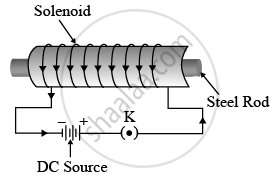
shaalaa.com
  Is there an error in this question or solution?
Chapter 13: Magnetic Effects of Electric Current - Short Answer Questions [Page 100]

APPEARS IN

NCERT Exemplar Science [English] Class 10
Chapter 13 Magnetic Effects of Electric Current
Short Answer Questions | Q 14. | Page 100

RELATED QUESTIONS

The figure shows a solenoid wound on a core of soft iron. Will the end A be a N pole or S pole when the current flows in the direction shown?  


The adjacent diagram shows a small magnet placed near a solenoid AB. Current is switched on in the solenoid by pressing the key K.

  1. State the polarity at the ends A and B.
  2. Will the magnet be attracted or repelled? Give a reason for your answer.


State two ways by which the magnetic field due to a current carrying solenoid can be made stronger.


What effect will there be on a magnetic compass when it is brought near a current carrying solenoid?


A current carrying solenoid behaves like a ______.


A current carrying solenoid when freely suspended, it always rests in ______ direction.


Draw the pattern of magnetic field lines of a solenoid through which a steady current flows. What does the pattern of field lines inside the solenoid indicate?


Draw magnetic field lines in and around a current-carrying straight solenoid.


Sketch the lines of force of the magnetic field of a solenoid. How does its field compare with that of a bar magnet?


What is a solenoid? Why do we usually keep its diameter small in comparison to its length?


Which of the following diagrams correctly shows the magnetic field produced by a current-carrying wire?


The pattern of the magnetic field produced by the straight current-carrying conducting wire is ____________.


The factors on which one magnetic field strength is produced by current-carrying solenoids depends are


The diagram below shows an insulated copper wire wound around a hollow cardboard cylindrical tube. Answer the questions that follow:

  1. What are the magnetic poles at A and B when the key K is closed?
  2. State two ways to increase the strength of the magnetic field in this coil without changing the coil.
  3. If we place a soft iron bar at the centre of the hollow cardboard and replace the DC source with an AC source then will it attract small iron pins toward itself when the current is flowing through the coil?

Ansari Sir was demonstrating an experiment in his class with the setup as shown in the figure below.

A magnet is attached to a spring. The magnet can go in and out of the stationary coil. He lifted the Magnet and released it to make it oscillate through the coil.
Based on your understanding of the phenomenon, answer the following question.

Is there any difference in the observations in the galvanometer when the Magnet swings in and then out of the stationary coil? Justify your answer.


Draw a neat diagram of a solenoid and name its various components.


Current is flowing through a coil as shown in the figure. Which one of the given figures will correctly depict the magnetic polarity and the direction of the lines of force along the axis of the coil?


Share
Notifications

Englishहिंदीमराठी


      Forgot password?
Use app×