Advertisements
Advertisements
Question
Two particles have the same de Broglie wavelength and one is moving four times as fast as the other. If the slower particle is an α-particle, what are the possibilities for the other particle?
Advertisements
Solution
Data:
λ1 = λ2,
v1 = 4v2
λ = `h/p = h/(mv)`
∴ `lambda_1 = h/(m_1v_1)`,
`lambda_2 = h/(m_2v_2)`
As λ1 = λ2,
m1v1 = m2v2
∴ `m_1 = (m_2 v_2)/v_1 = m_2 (1/4) = m_2/4`
As particle 2 is the ex-particle, particle 1 (having the mass `1/4` times that of the a-particle) may be a proton or neutron.
APPEARS IN
RELATED QUESTIONS
An electron, a proton, an α-particle, and a hydrogen atom are moving with the same kinetic energy. The associated de Broglie wavelength will be longest for ______.
State the importance of Davisson and Germer experiment.
What is the speed of a proton having de Broglie wavelength of 0.08 Å?
Explain what you understand by the de Broglie wavelength of an electron. Will an electron at rest have an associated de Broglie wavelength? Justify your answer.
The de Broglie wavelengths associated with an electron and a proton are the same. What will be the ratio of
- their momenta
- their kinetic energies?
Find the ratio of the de Broglie wavelengths of an electron and a proton when both are moving with the (a) same speed, (b) the same kinetic energy, and (c) the same momentum. State which of the two will have a longer wavelength in each case.
An electron is accelerated through a potential of 120 V. Find its de Broglie wavelength.
Calculate De Broglie's wavelength of the bullet moving with speed 90m/sec and having a mass of 5 gm.
The momentum of a photon of energy 1 MeV in kg m/s will be ______
If the radius of the innermost Bohr orbit is 0.53 Å, the radius of the 4th orbit is ______
According to de-Broglie hypothesis, the wavelength associated with moving electron of mass 'm' is 'λe'· Using mass energy relation and Planck's quantum theory, the wavelength associated with photon is 'λp'. If the energy (E) of electron and photon is same then relation between 'λe' and 'λp' is ______.
An electron of mass m and a photon have same energy E. The ratio of de-Broglie wavelengths associated with them is ( c being velocity of light) ______.
If the radius of the circular path and frequency of revolution of a particle of mass m are doubled, then the change in its kinetic energy will be (Ei and Ef are the initial and final kinetic energies of the particle respectively.)
A particle of charge q, mass m and energy E has de-Broglie wavelength `lambda.` For a particle of charge 2q, mass 2m and energy 2E, the de-Broglie wavelength is ____________.
How much energy is imparted to an electron so that its de-Broglie wavelength reduces from 10-10 m to 0.5 × 10⁻¹⁰ m? (E =energy of electron)
If '`lambda_1`' and '`lambda_2`' are de-Broglie wavelengths for electrons in first and second Bohr orbits in hydrogen atom, then the ratio '`lambda_2`' to '`lambda_1`' is (E1 = -13.6 eV) ____________.
If the kinetic energy of a particle is increased to 16 times its previous value, the percentage change in the de-Broglie wavelength of the particle is ____________.
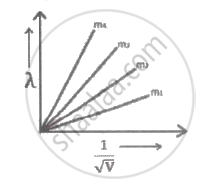
Graph shows the variation of de-Broglie wavelength `(lambda)` versus `1/sqrt"V"`, where 'V' is the accelerating potential for four particles carrying same charge but of masses m1 , m2, m3, m4. Which particle has a smaller mass?
According to de-Broglie hypothesis, the ratio of wavelength of an electron and that of photon having same energy 'E' is (m = mass of electron, c = velocity of light) ____________.
A photon of wavelength 3315 Å falls on a photocathode and an electron of energy 3 x 10-19 J is ejected. The threshold wavelength of photon is [Planck's constant (h) = 6.63 x 10⁻³⁴ J.s, velocity of light (c) = 3 x 10⁸ m/s] ____________.
Obtain an expression for de-Broglie wavelength of wave associated with material particles. The photoelectric work function for metal is 4.2 eV. Find the threshold wavelength.
A proton, a neutron, an electron and an α-particle have same energy. λp, λn, λe and λα are the de Broglie's wavelengths of proton, neutron, electron and α particle respectively, then choose the correct relation from the following :
The energy of an electron having de-Broglie wavelength `λ` is ______.
(h = Plank's constant, m = mass of electron)
An electron is accelerated through a potential difference of 100 volts. Calculate de-Broglie wavelength in nm.
A proton, an electron and an alpha particle have the same energies. Their de-Broglie wavelengths will be compared as ______.
A photon and an electron have an equal energy ‘E’. The ratio of wavelength ‘λp’ of photon to that of electron ‘λe’ is proportional to ______.
