Two heterozygous parents are crossed. If the two loci are linked, what would be the distribution of phenotypic features in the F1 generation for a dihybrid cross?
Advertisements
Question
Two heterozygous parents are crossed. If the two loci are linked, what would be the distribution of phenotypic features in the F1 generation for a dihybrid cross?
Advertisements
Solution
Two heterozygous parents (i.e., GgLl and GgLl) are crossed, and the two loci are linked; then the cross will be:
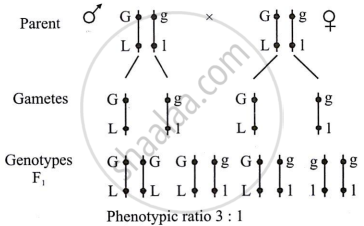
This means, if ‘G’ represents a grey body (dominant), ‘g’ a black body (recessive), ‘L’ long (dominant) and ‘l’ dwarf (recessive), then the distribution of phenotypic features in the F1 generation will be 3 : 1, i.e., `3/4` will show the dominant feature, grey and long, either in a homozygous (GGLL) or in a heterozygous (GgLl) condition and `1/4` will show the recessive feature, black and dwarf (ggll).
APPEARS IN
RELATED QUESTIONS
Multiple Choice Question
When two individuals differing in at least one character are crossed, the process is known as:
The physical expression of a gene is called ______.
Test cross involves
In pea plants, yellow seeds are dominant to green. If a heterozygous yellow seed pant is crossed with a green seeded plant, what ratio of yellow and green seeded plants would you expect in the F1 generation?
In a test cross involving F1 dihybrid flies, more parental type offspring were produced than the recombination type offspring. This indicates
Among the following characters which one was not considered by Mendel in his experimentation pea?
Name the seven contrasting traits of Mendel.
Define Genetics.
In a testcross involving F1 dihybrid flies, more parental-type offspring were produced than the recombinant-type offspring. This indicates ______.
A fruit fly exhibiting both male and female traits is ______.
Mendel’s Law of independent assortment holds good for genes situated on the ______.
From the list given below, select the character which can be acquired but not inherited
Do genetic combination of mothers play a significant role in determining the sex of a new born?
Sahil performed an experiment to study the inheritance pattern of genes. He crossed tall pea plants (TT) with short pea plants (tt) and obtained all tall plants in F1 generation.
What will be set of genes present in the F1 generation?
Sahil performed an experiment to study the inheritance pattern of genes. He crossed tall pea plants (TT) with short pea plants (tt) and obtained all tall plants in F1 generation.
When F1 plants were self-pollinated, a total of 800 plants were produced. How many of these would be tall, medium height or short plants? Give the genotype of F2 generation.
The Law of independent assortment is applicable for the traits which ______
The ratio of 9 : 3 : 3 : 1 is due to:
What is the first step in Mendel's experimental sequence for studying heredity?
Which of the following was NOT cited as a reason for the initial rejection of Mendel's work by the scientific community?
Which three scientists are credited with independently rediscovering Mendel's work in 1900?
Which plant species did Mendel primarily use in his hereditary experiments from 1856 to 1863?
Which aspect of Mendel's work was particularly difficult for the scientific community to accept during his lifetime?
What does Mendel's approach to counting and analyzing offspring demonstrate about the scientific method?
