Advertisements
Advertisements
Question
Two cylinders A and B of equal capacity are connected to each other via a stopcock. A contains a gas at standard temperature and pressure. B is completely evacuated. The entire system is thermally insulated. The stopcock is suddenly opened. Answer the following:
What is the final pressure of the gas in A and B?
Advertisements
Solution 1
0.5 atm
The volume available to the gas is doubled as soon as the stopcock between cylinders A and B is opened. Since volume is inversely proportional to pressure, the pressure will decrease to one-half of the original value. Since the initial pressure of the gas is 1 atm, the pressure in each cylinder will be 0.5 atm.
Solution 2
Since the final temperature and initial temperature remain the same,
`therefore "P"_2"V"_2 = "P"_1"V"_1`
But P1 = 1 atm, v1 = V, V2 = 2V and P2 = ?
`therefore "P"_2 = ("P"_1"V"_1)/"V"_2 = (1xx"V")/"2V"`
= 0.5 atm
APPEARS IN
RELATED QUESTIONS
Should the internal energy of a system necessarily increase if its temperature is increased?
A force F is applied on a block of mass M. The block is displaced through a distance d in the direction of the force. What is the work done by the force on the block? Does the internal energy change because of this work?
Can work be done by a system without changing its volume?
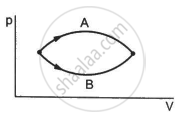
Figure shows two processes A and B on a system. Let ∆Q1 and ∆Q2 be the heat given to the system in processes A and B respectively. Then ____________ .
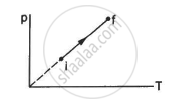
An ideal gas goes from the state i to the state f as shown in figure. The work done by the gas during the process ______________ .
The pressure p and volume V of an ideal gas both increase in a process.
(a) Such a process is not possible.
(b) The work done by the system is positive.
(c) The temperature of the system must increase.
(d) Heat supplied to the gas is equal to the change in internal energy.
A 100 kg lock is started with a speed of 2.0 m s−1 on a long, rough belt kept fixed in a horizontal position. The coefficient of kinetic friction between the block and the belt is 0.20. (a) Calculate the change in the internal energy of the block-belt system as the block comes to a stop on the belt. (b) Consider the situation from a frame of reference moving at 2.0 m s−1 along the initial velocity of the block. As seen from this frame, the block is gently put on a moving belt and in due time the block starts moving with the belt at 2.0 m s−1. calculate the increase in the kinetic energy of the block as it stops slipping past the belt. (c) Find the work done in this frame by the external force holding the belt.
When does a system lose energy to its surroundings and its internal energy decreases?
Explain given cases related to energy transfer between the system and surrounding –
- energy transferred (Q) > 0
- energy transferred (Q) < 0
- energy transferred (Q) = 0
Explain the different ways through which the internal energy of the system can be changed.
One gram of water (1 cm3) becomes 1671 cm3 of steam at a pressure of 1 atm. The latent heat of vaporization at this pressure is 2256 J/g. Calculate the external work and the increase in internal energy.
The internal energy of a system is ______
An ideal gas is compressed at a constant temperature. Its internal energy will ____________.
Which of the following represents isothermal process?
In insulated systems, the amount of external work done by the gas is proportional to:
Figure shows the P-V diagram of an ideal gas undergoing a change of state from A to B. Four different parts I, II, III and IV as shown in the figure may lead to the same change of state.
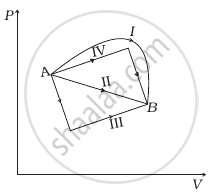
- Change in internal energy is same in IV and III cases, but not in I and II.
- Change in internal energy is same in all the four cases.
- Work done is maximum in case I
- Work done is minimum in case II.
In thermodynamics, heat and work are ______.
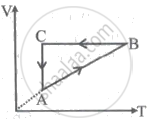
A cyclic process ABCA is shown in the V-T diagram. A process on the P-V diagram is ______.
What is heat?
