Advertisements
Advertisements
Question
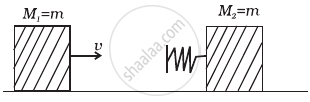
Two blocks M1 and M2 having equal mass are free to move on a horizontal frictionless surface. M2 is attached to a massless spring as shown in figure. Iniially M2 is at rest and M1 is moving toward M2 with speed v and collides head-on with M2.
- While spring is fully compressed all the KE of M1 is stored as PE of spring.
- While spring is fully compressed the system momentum is not conserved, though final momentum is equal to initial momentum.
- If spring is massless, the final state of the M1 is state of rest.
- If the surface on which blocks are moving has friction, then collision cannot be elastic.
Advertisements
Solution
c and d
Explanation:
If it is not specified we always consider the collision elastic.
When two bodies of equal masses collide elastically, their velocities are interchanged in these types of collision.
Kinetic energy and linear momentum remain conserved.
According to the above diagram when m1 comes in contact with the spring, m1 is retarded by the spring force and m2 is accelerated by the spring force.
- The spring will continue to compress until the two blocks acquire a common velocity. So some of the kinetic energy of block Mx is stored in P.E and some part of it stores in K.E of block M2. So option (a) is incorrect.
- As surfaces are frictionless momentum of the system will be conserved. So option (b) is also incorrect.
- The two bodies of equal mass exchange their velocities in a head-on elastic collision between them. So, if spring is massless, the final state of the M1 is a state of rest.
- Since there is a loss of K.E when the blocks collide on the rough surface. Hence, the collision is inelastic.
APPEARS IN
RELATED QUESTIONS
In an inelastic collision of two bodies, the quantities which do not change after the collision are the ______ of the system of two bodies.
Answer carefully, with reason:
Is the total linear momentum conserved during the short time of an elastic collision of two balls?
A bullet of mass 0.012 kg and horizontal speed 70 m s–1 strikes a block of wood of mass 0.4 kg and instantly comes to rest with respect to the block. The block is suspended from the ceiling by means of thin wires. Calculate the height to which the block rises. Also, estimate the amount of heat produced in the block.
Consider the decay of a free neutron at rest : n → p + e–
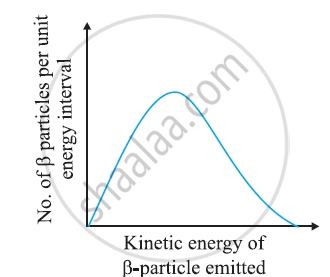
Show that the two-body decay of this type must necessarily give an electron of fixed energy and, therefore, cannot account for the observed continuous energy distribution in the β-decay of a neutron or a nucleus
Answer the following question.
Obtain its value for an elastic collision and a perfectly inelastic collision.
Answer the following question.
A bullet of mass m1 travelling with a velocity u strikes a stationary wooden block of mass m2 and gets embedded into it. Determine the expression for loss in the kinetic energy of the system. Is this violating the principle of conservation of energy? If not, how can you account for this loss?
Solve the following problem.
A marble of mass 2m travelling at 6 cm/s is directly followed by another marble of mass m with double speed. After a collision, the heavier one travels with the average initial speed of the two. Calculate the coefficient of restitution.
Define the following:
Coefficient of restitution
Arrive at an expression for elastic collision in one dimension and discuss various cases.
Two different unknown masses A and B collide. A is initially at rest when B has a speed v. After collision B has a speed v/2 and moves at right angles to its original direction of motion. Find the direction in which A moves after the collision.
Two bodies of masses 3 kg and 2 kg collide bead-on. Their relative velocities before and after collision are 20 m/s and 5 m/s respectively. The loss of kinetic energy of the system is ______.
A body of mas 'm' moving with speed 3 m/s collides with a body of mass '2m' at rest. The coalesced mass will start to move with a speed of ______.
During inelastic collision between two bodies, which of the following quantities always remain conserved?
In an elastic collision of two billiard balls, which of the following quantities remain conserved during the short time of collision of the balls (i.e., when they are in contact).
- Kinetic energy.
- Total linear momentum?
Give reason for your answer in each case.
A rod of mass M and length L is lying on a horizontal frictionless surface. A particle of mass 'm' travelling along the surface hits at one end of the rod with velocity 'u' in a direction perpendicular to the rod. The collision is completely elastic. After collision, particle comes to rest. The ratio of masses `(m/M)` is `1/x`. The value of 'x' will be ______.
A bag of sand of mass 9.8 kg is suspended by a rope. A bullet of 200 g travelling with speed 10 ms-1 gets embedded in it, then loss of kinetic energy will be ______.
An alpha-particle of mass m suffers 1-dimensional elastic collision with a nucleus at rest of unknown mass. It is scattered directly backwards losing, 64% of its initial kinetic energy. The mass of the nucleus is ______.
The dimension of mutual inductance is ______.
