Advertisements
Advertisements
Question
A molecule in a gas container hits a horizontal wall with speed 200 m s–1 and angle 30° with the normal, and rebounds with the same speed. Is momentum conserved in the collision? Is the collision elastic or inelastic?
Advertisements
Solution
Speed of molecule u = 200 m s-1, θ = 30°
Speed after rebound ν = 200 m s-1
∵ Momentum is conserved in every type of collision.
Therefore, momentum will be conserved in this collision also.
kinetic energy of the system when hitting the wall `"K"_1 = 1/2 "m""u"^2`
= `1/2"m" (200)^2 "J"`
kinetic energy after collision `"K"_2 = 1/2 "m""ν"^2`
= `1/2"m" (200)^2 "J"`
∴ The collision is elastic collision.
APPEARS IN
RELATED QUESTIONS
In an inelastic collision of two bodies, the quantities which do not change after the collision are the ______ of the system of two bodies.
State if the following statement is true or false. Give a reason for your answer.
In an elastic collision of two bodies, the momentum and energy of each body is conserved.
State if the following statement is true or false. Give a reason for your answer.
In an inelastic collision, the final kinetic energy is always less than the initial kinetic energy of the system.
Answer carefully, with reason:
In an elastic collision of two billiard balls, is the total kinetic energy conserved during the short time of collision of the balls (i.e. when they are in contact)?
Answer carefully, with reason:
Is the total linear momentum conserved during the short time of an elastic collision of two balls?
Answer the following question.
Obtain its value for an elastic collision and a perfectly inelastic collision.
A ball moving with velocity 5 m/s collides head on with another stationary ball of double mass. If the coefficient of restitution is 0.8, then their velocities (in m/s) after collision will be ____________.
A mass M moving with velocity 'v' along x-axis collides and sticks to another mass 2M which is moving along Y-axis with velocity 3v. After collision, the velocity of the combination is ______.
A smooth sphere of mass 'M' moving with velocity 'u' directly collides elastically with another sphere of mass 'm' at rest. After collision, their final velocities are V' and V respectively. The value of V is given by ______.
A bullet fired from gun with a velocity 30 m/s at an angle of 60° with horizontal direction. At the highest point of its path, the bullet explodes into two parts with masses in the ratio 1:3. The lighter mass comes to rest immediately. Then the speed of the heavier mass is
During inelastic collision between two bodies, which of the following quantities always remain conserved?
A ball of mass m, moving with a speed 2v0, collides inelastically (e > 0) with an identical ball at rest. Show that for head-on collision, both the balls move forward.
Consider a one-dimensional motion of a particle with total energy E. There are four regions A, B, C and D in which the relation between potential energy V, kinetic energy (K) and total energy E is as given below:
Region A : V > E
Region B : V < E
Region C : K > E
Region D : V > K
State with reason in each case whether a particle can be found in the given region or not.
Two pendulums with identical bobs and lengths are suspended from a common support such that in rest position the two bobs are in contact (Figure). One of the bobs is released after being displaced by 10° so that it collides elastically head-on with the other bob.
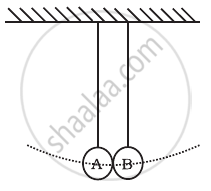
- Describe the motion of two bobs.
- Draw a graph showing variation in energy of either pendulum with time, for 0 ≤ t ≤ 2T, where T is the period of each pendulum.
A drunkard walking in a narrow lane takes 5 steps forward and 3 steps backward, followed again by 5 steps forward and 3 steps backward, and so on. Each step is 1 m long and required 1 s to cover. How long the drunkard takes to fall in a pit 13 m away from the start?
A ball falls from a height of 1 m on a ground and it loses half its kinetic energy when it hits the ground. What would be the total distance covered by the ball after sufficiently long time?
An insect moves with a constant velocity v from one corner of a room to other corner which is opposite of the first corner along the largest diagonal of room. If the insect can not fly and dimensions of room is a × a × a, then the minimum time in which the insect can move is `"a"/"v"`. times the square root of a number n, then n is equal to ______.
A bag of sand of mass 9.8 kg is suspended by a rope. A bullet of 200 g travelling with speed 10 ms-1 gets embedded in it, then loss of kinetic energy will be ______.
