Advertisements
Advertisements
Question
Two identical ball bearings in contact with each other and resting on a frictionless table are hit head-on by another ball bearing of the same mass moving initially with a speed V as shown in figure.
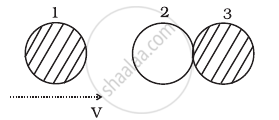
If the collision is elastic, which of the following (Figure) is a possible result after collision?
Options
Advertisements
Solution
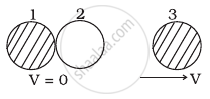
Explanation:
In a collision, if the motion of colliding particles before and after the collision is along the same line, the collision is said to be head-on or one-dimensional.
When two bodies of equal masses collide elastically, their velocities are interchanged.
Kinetic energy and linear momentum remain conserved Total kinetic energy of the system before the collision
= `1/2 mv^2 + 0 = 1/2 mv^2`
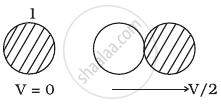
In (a), kinetic energy of the system after the collision.
`k_1 = 1/2 (2m) (v/2)^2 = 1/4 mv^2`
Hence this option is incorrect.
In (b), kinetic energy of the system after the collision.
`k_2 = 1/2 (m) (v)^2 = 1/2 mv^2`
Hence this option will be correct.
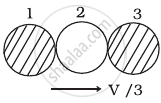
In (c), kinetic energy of the system after the collision.
`k_3 = 1/2 (3m) (v/3)^2 = 1/6 mv^2`
Hence this option is incorrect.
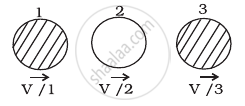
In (d), kinetic energy of the system after the collision.
`k_4 = 1/2 mv^2 + 1/2 m (v/2)^2 + 1/2 m(v/3)^2 = 49/72 mv^2`
We see that kinetic energy is conserved only in (b).
APPEARS IN
RELATED QUESTIONS
Answer carefully, with reason:
In an elastic collision of two billiard balls, is the total kinetic energy conserved during the short time of collision of the balls (i.e. when they are in contact)?
Answer carefully, with reason:
If the potential energy of two billiard balls depends only on the separation distance between their centres, is the collision elastic or inelastic? (Note, we are talking here of potential energy corresponding to the force during collision, not gravitational potential energy.)
A bullet of mass 0.012 kg and horizontal speed 70 m s–1 strikes a block of wood of mass 0.4 kg and instantly comes to rest with respect to the block. The block is suspended from the ceiling by means of thin wires. Calculate the height to which the block rises. Also, estimate the amount of heat produced in the block.
Answer the following question.
Obtain its value for an elastic collision and a perfectly inelastic collision.
Arrive at an expression for elastic collision in one dimension and discuss various cases.
In Rutherford experiment, for head-on collision of a-particles with a gold nucleus, the impact parameter is ______.
A wooden block of mass 'M' moves with velocity 'v ' and collides with another block of mass '4M' which is at rest. After collision, the block of mass 'M' comes to rest. The coefficient of restitution will be ______.
Two bodies of masses 3 kg and 2 kg collide bead-on. Their relative velocities before and after collision are 20 m/s and 5 m/s respectively. The loss of kinetic energy of the system is ______.
A body of mas 'm' moving with speed 3 m/s collides with a body of mass '2m' at rest. The coalesced mass will start to move with a speed of ______.
A smooth sphere of mass 'M' moving with velocity 'u' directly collides elastically with another sphere of mass 'm' at rest. After collision, their final velocities are V' and V respectively. The value of V is given by ______.
In an elastic collision of two billiard balls, which of the following quantities remain conserved during the short time of collision of the balls (i.e., when they are in contact).
- Kinetic energy.
- Total linear momentum?
Give reason for your answer in each case.
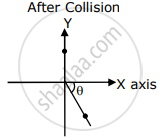
A ball of mass 10 kg moving with a velocity of 10`sqrt3` ms–1 along the X-axis, hits another ball of mass 20 kg which is at rest. After collision, the first ball comes to rest and the second one disintegrates into two equal pieces. One of the pieces starts moving along Y-axis at a speed of 10 m/s. The second piece starts moving at a speed of 20 m/s at an angle θ (degree) with respect to the X-axis.
The configuration of pieces after the collision is shown in the figure.
The value of θ to the nearest integer is ______.
A drunkard walking in a narrow lane takes 5 steps forward and 3 steps backward, followed again by 5 steps forward and 3 steps backward, and so on. Each step is 1 m long and required 1 s to cover. How long the drunkard takes to fall in a pit 13 m away from the start?
An insect moves with a constant velocity v from one corner of a room to other corner which is opposite of the first corner along the largest diagonal of room. If the insect can not fly and dimensions of room is a × a × a, then the minimum time in which the insect can move is `"a"/"v"`. times the square root of a number n, then n is equal to ______.
An alpha-particle of mass m suffers 1-dimensional elastic collision with a nucleus at rest of unknown mass. It is scattered directly backwards losing, 64% of its initial kinetic energy. The mass of the nucleus is ______.
Three identical blocks A, B and C are placed on horizontal frictionless surface. The blocks A and C are at rest. But A is approaching towards B with a speed 10 m/s. The coefficient of restitution for all collision is 0.5. The speed of the block C just after the collision is ______.

Answer carefully, with reason:
Is the total linear momentum conserved during the short time of an inelastic collision of two balls ?
In a collision, what type of interaction occurs between objects?
